Pearson+ LogoPearson+ Logo
Ch.17 Carboxylic Acids and Their Derivatives
McMurry - Fundamentals of GOB 8th Edition
McMurry8th EditionFundamentals of GOBISBN: 9780134015187Not the one you use?Change textbook
Chapter 17, Problem 14b

Write the products of the following reactions:
b. 2, 2-Dimethylpentanoic acid + KOH → ?

Verified step by step guidance
1
Identify the type of reaction: This is an acid-base reaction where 2,2-dimethylpentanoic acid (a carboxylic acid) reacts with potassium hydroxide (KOH, a strong base). The carboxylic acid will donate a proton (H⁺) to the hydroxide ion (OH⁻), forming water and the conjugate base of the acid.
Write the chemical formula for 2,2-dimethylpentanoic acid: The structure of 2,2-dimethylpentanoic acid is CH₃C(CH₃)₂CH₂CH₂COOH. The carboxylic acid group (-COOH) is the reactive site in this reaction.
Determine the conjugate base formed: When the carboxylic acid loses a proton (H⁺), it forms a carboxylate ion (-COO⁻). The conjugate base of 2,2-dimethylpentanoic acid is CH₃C(CH₃)₂CH₂CH₂COO⁻.
Combine the conjugate base with the potassium ion: The potassium ion (K⁺) from KOH will pair with the carboxylate ion to form the salt, potassium 2,2-dimethylpentanoate (CH₃C(CH₃)₂CH₂CH₂COOK).
Write the balanced reaction: The overall reaction is CH₃C(CH₃)₂CH₂CH₂COOH + KOH → CH₃C(CH₃)₂CH₂CH₂COOK + H₂O. This shows the formation of the salt and water as products.

Verified video answer for a similar problem:

This video solution was recommended by our tutors as helpful for the problem above.
Video duration:
2m
Was this helpful?

Key Concepts

Here are the essential concepts you must grasp in order to answer the question correctly.

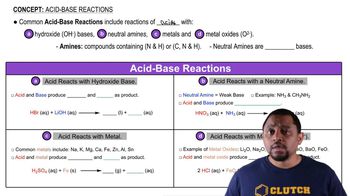
Acid-Base Reaction

An acid-base reaction involves the transfer of protons (H+) between reactants. In this case, 2,2-Dimethylpentanoic acid, a carboxylic acid, donates a proton to KOH, a strong base. This results in the formation of a salt and water, which is a typical outcome of neutralization reactions.
Recommended video:
Guided course
03:08
Acid-Base Reactions Concept 1

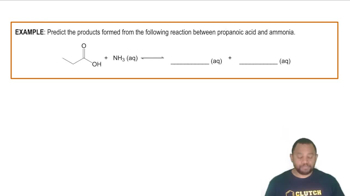
Carboxylic Acids

Carboxylic acids are organic compounds characterized by the presence of a carboxyl group (-COOH). They are known for their acidic properties due to the ability to donate protons. In the reaction with KOH, the carboxylic acid will react to form a carboxylate salt, which is a key product in acid-base reactions.
Recommended video:
Guided course
1:09
Carboxylic Acid Reactions Example 1

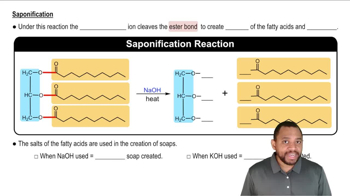
Potassium Hydroxide (KOH)

Potassium hydroxide is a strong base that dissociates completely in water to produce hydroxide ions (OH-). In the context of the reaction, KOH reacts with the carboxylic acid to neutralize it, leading to the formation of potassium salt of the acid and water. Understanding the role of KOH is essential for predicting the products of the reaction.
Recommended video:
Guided course
1:58
Triacylglycerol Reactions: Hydrolysis Concept 2