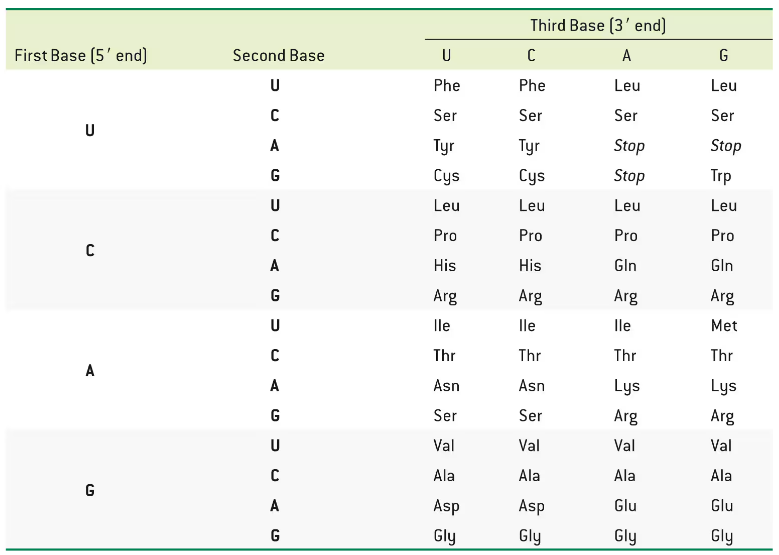
Look at Table 26.3 and find codons for the following amino acids: a. Val
Verified step by step guidance
1
Step 1: Understand the problem. The question asks us to find the codons that correspond to the amino acid Valine (Val) using Table 26.3, which is a codon chart or table that maps mRNA codons to their respective amino acids.
Step 2: Recall that codons are sequences of three nucleotides (triplets) in mRNA that code for specific amino acids. For example, codons are written in the form of 'AUG', where each letter represents a nucleotide (A = Adenine, U = Uracil, G = Guanine, C = Cytosine).
Step 3: Locate Valine (Val) in the codon chart (Table 26.3). Identify all the codons listed under Valine. Typically, a single amino acid can have multiple codons due to the redundancy of the genetic code.
Step 4: Write down the codons for Valine as they appear in the table. For example, Valine is often associated with codons such as 'GUU', 'GUC', 'GUA', and 'GUG'.
Step 5: Verify your findings by cross-checking the codons with the table to ensure accuracy. This step ensures that you have correctly identified all codons corresponding to Valine.
Verified video answer for a similar problem:
This video solution was recommended by our tutors as helpful for the problem above
Video duration:
1m
Play a video:
Was this helpful?
Key Concepts
Here are the essential concepts you must grasp in order to answer the question correctly.
Codons
Codons are sequences of three nucleotides in DNA or RNA that correspond to specific amino acids or stop signals during protein synthesis. Each codon is part of the genetic code, which translates the information encoded in genes into functional proteins. Understanding codons is essential for interpreting how genetic information is expressed in living organisms.
Amino acids are organic compounds that serve as the building blocks of proteins. There are 20 standard amino acids, each with a unique side chain that determines its properties and role in protein structure and function. The sequence of amino acids in a protein is dictated by the corresponding codons in the mRNA, making it crucial to know which codons correspond to which amino acids.
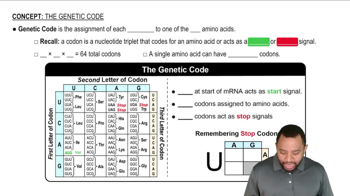
The genetic code is a set of rules that defines how the sequence of nucleotides in DNA or RNA is translated into the amino acid sequence of proteins. It is universal among almost all organisms, consisting of 64 codons that specify 20 amino acids and stop signals. Familiarity with the genetic code is vital for understanding how genetic information is utilized in biological processes.