Pearson+ LogoPearson+ Logo
Ch.26 Nucleic Acids and Protein Synthesis
McMurry - Fundamentals of GOB 8th Edition
McMurry8th EditionFundamentals of GOBISBN: 9780134015187Not the one you use?Change textbook
Chapter 26, Problem 51

Rank the following in order of size: tRNA, DNA, mRNA.

Verified step by step guidance
1
Understand the biological molecules involved: tRNA (transfer RNA), DNA (deoxyribonucleic acid), and mRNA (messenger RNA). These molecules differ in size and function within the cell.
Recall that DNA is typically the largest molecule among the three. It contains the genetic blueprint for an organism and is composed of long chains of nucleotides organized into chromosomes.
Consider mRNA, which is synthesized from DNA during transcription. mRNA is smaller than DNA because it represents only a specific segment of the genetic code needed for protein synthesis.
Evaluate tRNA, which is the smallest of the three. tRNA molecules are compact and specialized for transferring amino acids during translation, making them significantly smaller than both DNA and mRNA.
Rank the molecules in order of size based on the above information: DNA (largest), mRNA (intermediate), tRNA (smallest).

Verified video answer for a similar problem:

This video solution was recommended by our tutors as helpful for the problem above.
Video duration:
2m
Was this helpful?

Key Concepts

Here are the essential concepts you must grasp in order to answer the question correctly.

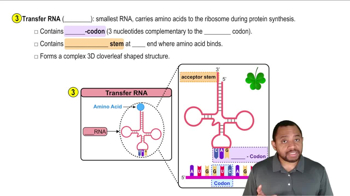
tRNA (Transfer RNA)

tRNA is a small RNA molecule, typically about 76 to 90 nucleotides long, that plays a crucial role in protein synthesis. It carries amino acids to the ribosome, where proteins are assembled, and has an anticodon that pairs with the corresponding codon on mRNA. Its relatively small size compared to other RNA and DNA types makes it the shortest among the three.
Recommended video:
Guided course
2:23
Types of RNA Concept 2

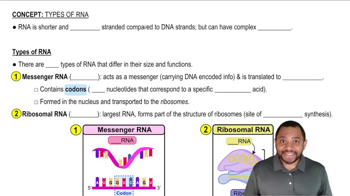
mRNA (Messenger RNA)

mRNA is a single-stranded RNA molecule that conveys genetic information from DNA to the ribosome, where proteins are synthesized. It is generally longer than tRNA, ranging from hundreds to thousands of nucleotides, depending on the gene being expressed. mRNA serves as a template for translation, making it larger than tRNA but smaller than DNA.
Recommended video:
Guided course
2:43
Types of RNA Concept 1

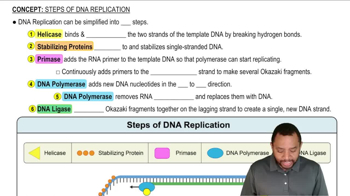
DNA (Deoxyribonucleic Acid)

DNA is a double-stranded molecule that contains the genetic blueprint for all living organisms. It is composed of long chains of nucleotides, with a typical length of millions of base pairs, making it the largest of the three types of nucleic acids. DNA's structure allows it to store and transmit genetic information, which is essential for growth, development, and reproduction.
Recommended video:
Guided course
5:08
Steps of DNA Replication Concept 1