Pearson+ LogoPearson+ Logo
Ch.26 Nucleic Acids and Protein Synthesis
McMurry - Fundamentals of GOB 8th Edition
McMurry8th EditionFundamentals of GOBISBN: 9780134015187Not the one you use?Change textbook
Chapter 26, Problem 56

What is an anticodon, and on what kind of nucleic acid is it found?

Verified step by step guidance
1
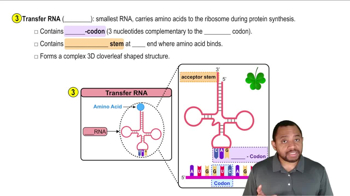
Understand the concept of an anticodon: An anticodon is a sequence of three nucleotides that is complementary to a codon on messenger RNA (mRNA). It plays a crucial role in protein synthesis during translation.
Identify the type of nucleic acid where anticodons are found: Anticodons are located on transfer RNA (tRNA), which is a type of RNA responsible for bringing amino acids to the ribosome during translation.
Learn the relationship between codons and anticodons: Codons are three-nucleotide sequences on mRNA that specify a particular amino acid. The anticodon on tRNA pairs with the codon on mRNA through complementary base pairing.
Explore the base pairing rules: The bases in the anticodon pair with the bases in the codon according to the rules of complementary base pairing (adenine pairs with uracil, and cytosine pairs with guanine in RNA).
Understand the role of anticodons in translation: During translation, the anticodon ensures that the correct amino acid is added to the growing polypeptide chain by matching the codon on mRNA with the corresponding amino acid carried by the tRNA.

Verified video answer for a similar problem:

This video solution was recommended by our tutors as helpful for the problem above.
Video duration:
1m
Was this helpful?

Key Concepts

Here are the essential concepts you must grasp in order to answer the question correctly.

Anticodon

An anticodon is a sequence of three nucleotides in transfer RNA (tRNA) that is complementary to a corresponding codon in messenger RNA (mRNA). It plays a crucial role in the process of translation, where the anticodon pairs with the codon to ensure the correct amino acid is added to the growing polypeptide chain during protein synthesis.
Recommended video:
Guided course
2:23
Types of RNA Concept 2

tRNA (Transfer RNA)

Transfer RNA (tRNA) is a type of nucleic acid that serves as an adaptor molecule in protein synthesis. Each tRNA molecule carries a specific amino acid and has an anticodon that matches a codon on the mRNA strand. This pairing is essential for translating the genetic code into functional proteins.
Recommended video:
Guided course
2:23
Types of RNA Concept 2

Codon

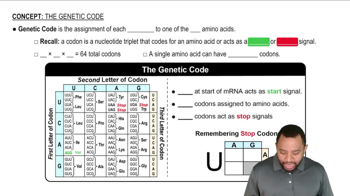
A codon is a sequence of three nucleotides in mRNA that specifies a particular amino acid or a stop signal during protein synthesis. Codons are read by the ribosome during translation, and the sequence of codons determines the order of amino acids in a protein, ultimately influencing its structure and function.
Recommended video:
Guided course
03:25
The Genetic Code Concept 1