Pearson+ LogoPearson+ Logo
Ch.26 Nucleic Acids and Protein Synthesis
McMurry - Fundamentals of GOB 8th Edition
McMurry8th EditionFundamentals of GOBISBN: 9780134015187Not the one you use?Change textbook
Chapter 26, Problem 57a

Which amino acid(s) have the most codons?

Verified step by step guidance
1
Understand that codons are sequences of three nucleotides in mRNA that correspond to specific amino acids or stop signals during protein synthesis.
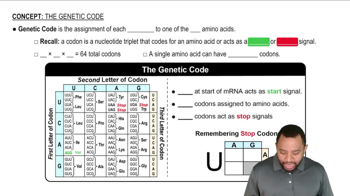
Recall that there are 64 possible codons in the genetic code, but only 20 amino acids are encoded, meaning some amino acids are represented by multiple codons.
Identify that amino acids with the most codons are those with the highest redundancy in the genetic code. For example, leucine, serine, and arginine each have six codons.
Review the genetic code table to confirm which amino acids have the highest number of codons and compare them to others with fewer codons.
Conclude that amino acids with six codons (leucine, serine, and arginine) are the ones with the most codons, based on the genetic code table.

Verified video answer for a similar problem:

This video solution was recommended by our tutors as helpful for the problem above.
Video duration:
41s
Was this helpful?

Key Concepts

Here are the essential concepts you must grasp in order to answer the question correctly.

Codons

Codons are sequences of three nucleotides in mRNA that correspond to specific amino acids or stop signals during protein synthesis. There are 64 possible codons, but only 20 standard amino acids, leading to redundancy in the genetic code. This redundancy means that some amino acids are encoded by multiple codons, which is crucial for understanding which amino acids have the most codons.
Recommended video:
Guided course
03:25
The Genetic Code Concept 1

Amino Acids

Amino acids are organic compounds that serve as the building blocks of proteins. There are 20 standard amino acids, each defined by its unique side chain or R group. The diversity in codons allows for certain amino acids, like leucine, serine, and arginine, to be encoded by multiple codons, which is important for protein synthesis and function.
Recommended video:
Guided course
3:03
Amino Acid Catabolism: Amino Group Example 2

Genetic Code

The genetic code is the set of rules by which information encoded in genetic material is translated into proteins. It consists of codons that specify which amino acids will be added during protein synthesis. Understanding the genetic code is essential for determining which amino acids have the most codons, as it reveals the relationships between nucleotide sequences and the resulting amino acids.
Recommended video:
Guided course
03:25
The Genetic Code Concept 1