Pearson+ LogoPearson+ Logo
Ch.26 Nucleic Acids and Protein Synthesis
McMurry - Fundamentals of GOB 8th Edition
McMurry8th EditionFundamentals of GOBISBN: 9780134015187Not the one you use?Change textbook
Chapter 26, Problem 8a

Write the complementary sequence of bases for each DNA strand shown next.
a. 5′T-A-T-A-C-T-G 3′

Verified step by step guidance
1
Identify the base-pairing rules for DNA: Adenine (A) pairs with Thymine (T), and Cytosine (C) pairs with Guanine (G).
Write the complementary base for each nucleotide in the given sequence, starting from the 5′ end of the original strand. For example, if the original strand has 'T', the complementary base will be 'A'.
Ensure the complementary strand is written in the 3′ to 5′ direction, as DNA strands are antiparallel.
For the given sequence 5′T-A-T-A-C-T-G 3′, apply the base-pairing rules to each nucleotide: T pairs with A, A pairs with T, C pairs with G, and G pairs with C.
Write the final complementary sequence in the 3′ to 5′ direction, ensuring the correct orientation of the strand.

Verified video answer for a similar problem:

This video solution was recommended by our tutors as helpful for the problem above.
Video duration:
3m
Was this helpful?

Key Concepts

Here are the essential concepts you must grasp in order to answer the question correctly.

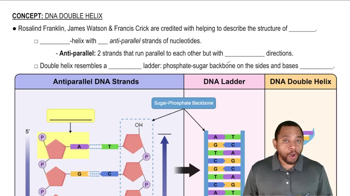
DNA Structure

DNA is composed of two strands forming a double helix, with each strand made up of nucleotides. Each nucleotide consists of a sugar, a phosphate group, and a nitrogenous base. The four types of nitrogenous bases are adenine (A), thymine (T), cytosine (C), and guanine (G). The bases pair specifically: A with T and C with G, which is crucial for understanding complementary sequences.
Recommended video:
Guided course
3:27
DNA Double Helix Concept 1

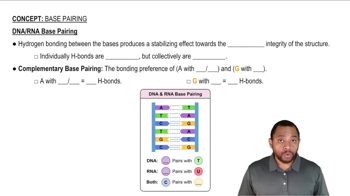
Complementary Base Pairing

Complementary base pairing refers to the specific pairing of nitrogenous bases in DNA. Adenine pairs with thymine (A-T), and cytosine pairs with guanine (C-G). This pairing is essential for DNA replication and transcription, as it ensures that the genetic information is accurately copied and transmitted. Understanding this concept is key to determining the complementary sequence of a given DNA strand.
Recommended video:
Guided course
2:56
Base Pairing Concept 1

5' and 3' Ends of DNA Strands

DNA strands have directionality, indicated by the 5' (five-prime) and 3' (three-prime) ends. The 5' end has a phosphate group, while the 3' end has a hydroxyl group. When writing or reading DNA sequences, it is important to maintain this orientation, as it affects how the strands interact during processes like replication and transcription. This directional aspect is crucial for accurately determining complementary sequences.
Recommended video:
Guided course
1:05
Intro to DNA Replication Example 3