Pearson+ LogoPearson+ Logo
Ch.26 Nucleic Acids and Protein Synthesis
McMurry - Fundamentals of GOB 8th Edition
McMurry8th EditionFundamentals of GOBISBN: 9780134015187Not the one you use?Change textbook
Chapter 26, Problem 9

Draw the structures of adenine and uracil (which replaces thymine in RNA), and show the hydrogen bonding that occurs between them.

Verified step by step guidance
1
Step 1: Understand the molecular structures of adenine and uracil. Adenine is a purine base with a double-ring structure containing nitrogen atoms, while uracil is a pyrimidine base with a single-ring structure containing nitrogen and oxygen atoms.
Step 2: Draw the structure of adenine. Represent its double-ring system with the correct placement of nitrogen atoms and hydrogen atoms. Ensure the amino group (-NH₂) is attached to the 6th carbon of the larger ring.
Step 3: Draw the structure of uracil. Represent its single-ring system with the correct placement of nitrogen atoms, carbonyl groups (C=O), and hydrogen atoms. Uracil has two carbonyl groups at positions 2 and 4 and a hydrogen atom bonded to the nitrogen at position 3.
Step 4: Identify the hydrogen bonding sites. In adenine, the amino group (-NH₂) and a nitrogen atom in the ring can act as hydrogen bond donors or acceptors. In uracil, the carbonyl groups (C=O) act as hydrogen bond acceptors, and the hydrogen attached to the nitrogen can act as a donor.
Step 5: Illustrate the hydrogen bonding between adenine and uracil. Show the hydrogen bonds (dotted lines) between the hydrogen of adenine's amino group and one of uracil's carbonyl oxygens, as well as between a nitrogen in adenine's ring and the hydrogen attached to uracil's nitrogen. Ensure the bonds are aligned to reflect proper hydrogen bonding geometry.

Verified video answer for a similar problem:

This video solution was recommended by our tutors as helpful for the problem above.
Video duration:
5m
Was this helpful?

Key Concepts

Here are the essential concepts you must grasp in order to answer the question correctly.

Nucleotide Structure

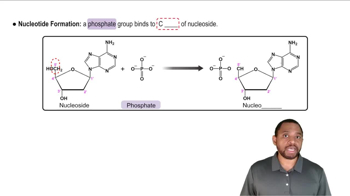
Nucleotides are the building blocks of nucleic acids like DNA and RNA. Each nucleotide consists of a nitrogenous base (adenine, thymine, uracil, or cytosine), a sugar molecule (ribose in RNA and deoxyribose in DNA), and a phosphate group. Understanding the structure of adenine and uracil is essential for grasping how they function in RNA.
Recommended video:
Guided course
1:19
Nucleoside and Nucleotide Formation Concept 2

Hydrogen Bonding

Hydrogen bonding is a type of weak chemical bond that occurs when a hydrogen atom covalently bonded to an electronegative atom, like nitrogen or oxygen, experiences an attraction to another electronegative atom. In the context of RNA, adenine and uracil form two hydrogen bonds with each other, which is crucial for the stability of RNA structures and their function in protein synthesis.
Recommended video:
Guided course
1:22
Hydrogenation Reactions Concept 1

Base Pairing Rules

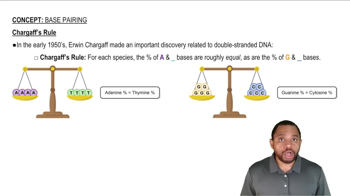
Base pairing rules dictate how nitrogenous bases pair with each other in nucleic acids. In RNA, adenine pairs with uracil instead of thymine, which is found in DNA. This specific pairing is vital for the accurate transcription and translation of genetic information, ensuring that the correct amino acids are assembled during protein synthesis.
Recommended video:
Guided course
2:01
Base Pairing Concept 2