Pearson+ LogoPearson+ Logo
Ch.10 Proteins Workers of the Cell
Frost - General, Organic and Biological Chemistry 4th Edition
Frost4th EditionGeneral, Organic and Biological ChemistryISBN: 9780134988696Not the one you use?Change textbook
Chapter 6, Problem 73a

For each of the following proteins, note whether the main secondary structure feature is α helix, β-pleated sheet, or both.
a. collagen

Verified step by step guidance
1
Understand the concept of secondary structures in proteins: Proteins have secondary structures that are stabilized by hydrogen bonding. The two main types are α helix (a coiled structure) and β-pleated sheet (a sheet-like structure).
Recall the structure of collagen: Collagen is a structural protein found in connective tissues such as skin, tendons, and bones. It has a unique triple-helix structure, which is a variation of the α helix.
Identify the dominant secondary structure in collagen: Collagen's triple-helix structure is primarily based on the α helix, but it is not a standard α helix. Instead, it is a specialized form adapted for its structural role.
Note that β-pleated sheets are not a feature of collagen: Collagen does not contain β-pleated sheets as part of its secondary structure.
Conclude that the main secondary structure feature of collagen is the α helix, specifically in the form of a triple helix.

Verified video answer for a similar problem:

This video solution was recommended by our tutors as helpful for the problem above.
Video duration:
3m
Was this helpful?

Key Concepts

Here are the essential concepts you must grasp in order to answer the question correctly.

Secondary Structure of Proteins

The secondary structure of proteins refers to the local folded structures that form within a polypeptide due to hydrogen bonding between backbone atoms. The two most common types are α helices, which are coiled structures, and β-pleated sheets, which are formed by parallel or antiparallel strands. Understanding these structures is crucial for analyzing protein function and stability.
Recommended video:
Guided course
1:24
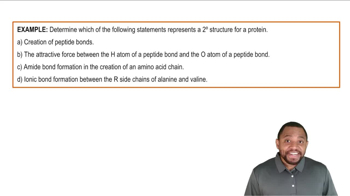
Secondary Protein Structure Example 2

Collagen Structure

Collagen is a structural protein that primarily consists of a unique triple helix formation, which is a type of α helix. This structure provides tensile strength and is a major component of connective tissues. While collagen does not typically form β-pleated sheets, its unique helical structure is essential for its biological function.
Recommended video:
Guided course
1:01
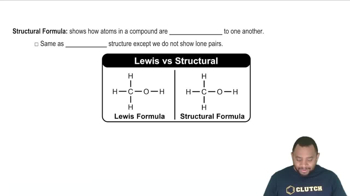
Structural Formula Concept 2

Protein Folding and Function

The folding of proteins into specific secondary structures is critical for their overall three-dimensional shape and function. The arrangement of α helices and β-pleated sheets influences how proteins interact with other molecules and perform their biological roles. Understanding these relationships helps in fields like biochemistry and molecular biology.
Recommended video:
Guided course
02:16
Logarithmic Functions