Pearson+ LogoPearson+ Logo
Ch.18 Amino Acids and Proteins
McMurry - Fundamentals of GOB 8th Edition
McMurry8th EditionFundamentals of GOBISBN: 9780134015187Not the one you use?Change textbook
Chapter 18, Problem 36

Draw the hexapeptide Asp-Gly-Phe-Leu-Glu-Ala in linear form showing all of the atoms, and show (using dotted lines) the hydrogen bonding that stabilizes this structure if it is part of an α-helix.

Verified step by step guidance
1
Step 1: Write out the sequence of the hexapeptide Asp-Gly-Phe-Leu-Glu-Ala in linear form. Begin by identifying the amino acids and their structures. Each amino acid consists of an amino group (-NH₂), a carboxyl group (-COOH), and a unique side chain (R group). Connect the amino acids through peptide bonds (-CONH-).
Step 2: Draw the peptide bonds between the amino acids. A peptide bond forms when the carboxyl group of one amino acid reacts with the amino group of the next amino acid, releasing a molecule of water (condensation reaction). Ensure the backbone alternates between -N-C-C- for each amino acid.
Step 3: Add the side chains (R groups) for each amino acid to the central carbon (α-carbon) of the backbone. For example, Asp has a -CH₂-COOH side chain, Gly has a hydrogen atom as its side chain, Phe has a benzyl group (-CH₂-C₆H₅), and so on. Ensure the side chains are correctly positioned.
Step 4: To show the hydrogen bonding that stabilizes the α-helix, identify the hydrogen bond donors (N-H groups) and acceptors (C=O groups) in the peptide backbone. In an α-helix, hydrogen bonds form between the carbonyl oxygen of one amino acid and the amide hydrogen of another amino acid located four residues away in the sequence.
Step 5: Use dotted lines to represent the hydrogen bonds between the carbonyl oxygen and the amide hydrogen. Ensure the hydrogen bonds are drawn parallel to the axis of the helix, stabilizing the structure. Label the hydrogen bonds clearly to indicate their role in maintaining the α-helix conformation.

Verified video answer for a similar problem:

This video solution was recommended by our tutors as helpful for the problem above.
Was this helpful?

Key Concepts

Here are the essential concepts you must grasp in order to answer the question correctly.

Peptide Structure

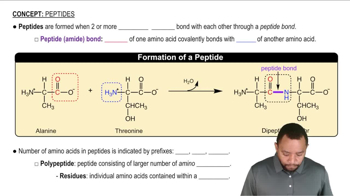
A peptide is a short chain of amino acids linked by peptide bonds. In the case of the hexapeptide Asp-Gly-Phe-Leu-Glu-Ala, each amino acid contributes a specific side chain that influences the peptide's properties and interactions. Understanding the linear representation of this sequence is crucial for visualizing how the amino acids are arranged and how they interact with one another.
Recommended video:
Guided course
3:07
Peptides Concept 1

Hydrogen Bonding in α-Helices

Hydrogen bonds play a critical role in stabilizing the secondary structure of proteins, particularly in α-helices. In an α-helix, hydrogen bonds form between the carbonyl oxygen of one amino acid and the amide hydrogen of another, typically four residues down the chain. This bonding pattern contributes to the helical shape and stability of the structure, which is essential for the overall function of the protein.
Recommended video:
Guided course
1:22
Hydrogenation Reactions Concept 1

Linear vs. Tertiary Structure

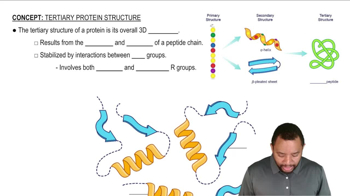
The linear form of a peptide represents its primary structure, which is the sequence of amino acids. However, proteins often fold into complex tertiary structures that are stabilized by various interactions, including hydrogen bonds, ionic bonds, and hydrophobic interactions. Understanding the distinction between linear and tertiary structures is vital for grasping how the sequence of amino acids influences the final three-dimensional shape and function of the protein.
Recommended video:
Guided course
2:07
Tertiary Protein Structure Concept 1
Related Practice
Textbook Question

Draw the structure of the following amino acids, dipeptides, and tripeptides at low pH (pH 1) and high pH (pH 14). At each pH, assume that all functional groups that might do so are ionized.

d. Glu-Asp

194
views
Textbook Question

Draw the structure of the following amino acids, dipeptides, and tripeptides at low pH (pH 1) and high pH (pH 14). At each pH, assume that all functional groups that might do so are ionized.

e. Gln-Ala-Asn

290
views
Textbook Question

Interactions of amino acids on the interior of proteins are key to the shapes of proteins. In group (a), which pairs of amino acids form hydrophobic interactions? In group (b), which pairs form ionic interactions? Which pairs in group (c) form hydrogen bonds?

a. 1 Pro . . . Phe

   2 Lys . . . Ser

   3 Thr . . . Leu

   4 Ala . . . Gly

132
views
Textbook Question

Compare and contrast the characteristics of fibrous and globular proteins. Consider biological function, water solubility, amino acid composition, secondary structure, and tertiary structure. Give examples of three fibrous and three globular proteins. (Hint: Make a table.)

526
views
Textbook Question

Cell membranes are studded with proteins. Some of these proteins, involved in the transport of molecules across the membrane into the cell, span the entire membrane and are called transmembrane proteins. The interior of the cell membrane is hydrophobic and nonpolar, whereas both the extracellular and intracellular fluids are water-based.

a. List three amino acids you would expect to find in the part of a transmembrane protein that lies within the cell membrane.

849
views
Textbook Question

Threonine has two chiral centers. Draw L-threonine and indicate which carbon atoms are chiral. Which carbon atom is responsible for D and L configuration?

925
views