Pearson+ LogoPearson+ Logo
Ch.20 Carbohydrates
McMurry - Fundamentals of GOB 8th Edition
McMurry8th EditionFundamentals of GOBISBN: 9780134015187Not the one you use?Change textbook
Chapter 20, Problem 41

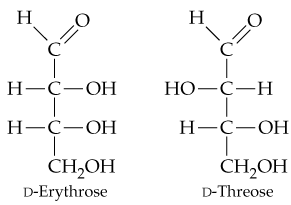
In Section 15.6, you saw that aldehydes react with reducing agents to yield primary alcohols (RCH=O → RCH2OH). The structures of two D-aldotetroses are shown. One of them can be reduced to yield a chiral product, but the other yields an achiral product. Explain.

Verified step by step guidance
1
Step 1: Understand the reaction. Aldehydes (RCH=O) react with reducing agents to form primary alcohols (RCH₂OH). This involves the addition of hydrogen to the carbonyl group, converting the double bond to a single bond and adding a hydroxyl group (-OH) to the carbon.
Step 2: Analyze the structures of the two d-aldotetroses. Aldotetroses are four-carbon sugars with an aldehyde group at one end and hydroxyl groups attached to the other carbons. The chirality of the product depends on the symmetry of the molecule after reduction.
Step 3: Consider the concept of chirality. A molecule is chiral if it has a non-superimposable mirror image, often due to the presence of a carbon atom bonded to four different groups. If the product has a plane of symmetry, it will be achiral.
Step 4: Examine the reduction process. When the aldehyde group is reduced to a primary alcohol, the resulting molecule will have a hydroxyl group (-OH) at the end. For one of the d-aldotetroses, this reduction creates a molecule with a plane of symmetry, making it achiral. For the other, the reduction does not introduce symmetry, so the product remains chiral.
Step 5: Identify the specific d-aldotetroses. The d-aldotetrose that yields an achiral product likely has a symmetric arrangement of hydroxyl groups after reduction, while the one that yields a chiral product has an asymmetric arrangement. Carefully compare the structures of the two d-aldotetroses to determine which is which.

Verified video answer for a similar problem:

This video solution was recommended by our tutors as helpful for the problem above.
Video duration:
1m
Was this helpful?

Key Concepts

Here are the essential concepts you must grasp in order to answer the question correctly.

Aldehyde Reduction

Aldehyde reduction is a chemical reaction where an aldehyde (RCH=O) is converted into a primary alcohol (RCH₂OH) through the addition of hydrogen or a reducing agent. This process is significant in organic chemistry as it alters the functional group of the molecule, impacting its reactivity and properties. The stereochemistry of the resulting alcohol can vary depending on the structure of the aldehyde and the conditions of the reaction.
Recommended video:
Guided course
1:57
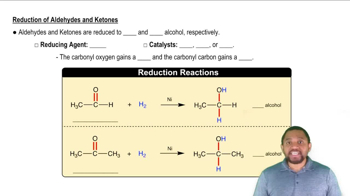
Reduction of Aldehydes and Ketones Concept 2

Chirality

Chirality refers to the geometric property of a molecule having non-superimposable mirror images, much like left and right hands. A chiral molecule typically has at least one carbon atom bonded to four different substituents, leading to two distinct enantiomers. In the context of aldehyde reduction, the formation of a chiral product indicates that the reduction process creates a new stereocenter, which can result in two different optical isomers.
Recommended video:
Guided course
1:39
Chirality Example 1

Achirality

Achirality describes molecules that are superimposable on their mirror images, meaning they do not have a chiral center. Such molecules can be symmetrical or have identical substituents around a central atom, leading to a single form without enantiomers. In the case of aldehyde reduction, if the starting aldehyde is achiral, the resulting alcohol will also be achiral, as the reduction does not introduce any new stereocenters.
Recommended video:
Guided course
2:37
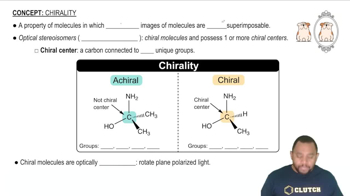
Chirality Concept 1