Pearson+ LogoPearson+ Logo
Ch.20 Carbohydrates
McMurry - Fundamentals of GOB 8th Edition
McMurry8th EditionFundamentals of GOBISBN: 9780134015187Not the one you use?Change textbook
Chapter 20, Problem 52

Treatment of D-glucose with a reducing agent yields sorbitol, a substance used as a sugar substitute by people with diabetes. Draw the structure of sorbitol.

Verified step by step guidance
1
Understand the context: d-glucose is a monosaccharide (a simple sugar) with an aldehyde functional group (-CHO) at the first carbon. When treated with a reducing agent, the aldehyde group is reduced to a primary alcohol (-CH2OH). This process converts d-glucose into sorbitol, a sugar alcohol.
Identify the structure of d-glucose: d-glucose is a six-carbon sugar (hexose) with the molecular formula C6H12O6. It has a linear form and a cyclic form, but for this reaction, focus on the linear form where the aldehyde group is present at the first carbon.
Apply the reduction reaction: A reducing agent donates electrons to the aldehyde group (-CHO) at the first carbon of d-glucose, converting it into a primary alcohol (-CH2OH). This changes the functional group at the first carbon while leaving the rest of the molecule unchanged.
Draw the structure of sorbitol: After the reduction, the molecule will have six carbons, each with a hydroxyl group (-OH) attached. The first carbon, which originally had the aldehyde group, now has a hydroxyl group (-OH) and a hydrogen (-H), forming a primary alcohol.
Verify the structure: Ensure that the final structure of sorbitol has the correct number of carbons (6), hydrogens (14), and oxygens (6), with hydroxyl groups (-OH) attached to each carbon. This confirms that the reduction of d-glucose to sorbitol is complete.

Verified video answer for a similar problem:

This video solution was recommended by our tutors as helpful for the problem above.
Video duration:
1m
Was this helpful?

Key Concepts

Here are the essential concepts you must grasp in order to answer the question correctly.

D-Glucose Structure

D-glucose is a simple sugar (monosaccharide) with the molecular formula C6H12O6. It has a six-carbon backbone and exists in a cyclic form, typically as a pyranose (six-membered ring). Understanding its structure is essential for recognizing how it can be chemically modified to produce other compounds, such as sorbitol.
Recommended video:
Guided course
2:48
Total Energy From Glucose Concept 2

Reducing Agents

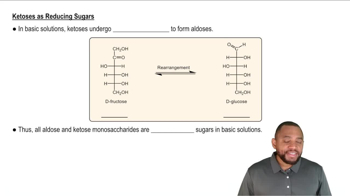
Reducing agents are substances that donate electrons in a chemical reaction, leading to the reduction of another substance. In the context of glucose, a reducing agent can convert the aldehyde group of D-glucose into an alcohol group, resulting in the formation of sorbitol. This transformation is crucial for understanding how sugar substitutes are synthesized.
Recommended video:
Guided course
1:03
Ketoses as Reducing Sugars Concept 2

Sorbitol Structure

Sorbitol, also known as glucitol, is a sugar alcohol derived from D-glucose. Its structure features a six-carbon chain with hydroxyl (-OH) groups attached to each carbon, making it a polyol. Sorbitol is commonly used as a sugar substitute due to its lower caloric content and minimal impact on blood sugar levels, which is particularly beneficial for individuals with diabetes.
Recommended video:
Guided course
1:01
Structural Formula Concept 2