Draw the following three isomers of C5H12 as condensed structures: c.
Verified step by step guidance
1
Step 1: Understand the problem. The molecular formula C₅H₁₂ corresponds to an alkane, which is a hydrocarbon with only single bonds. Isomers are compounds with the same molecular formula but different structural arrangements. For C₅H₁₂, we need to draw three different structural isomers.
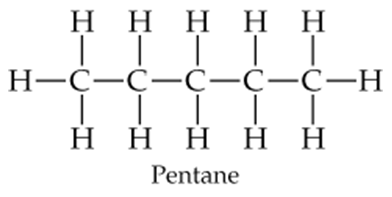
Step 2: Start with the simplest structure, the straight-chain alkane (n-pentane). Arrange all five carbon atoms in a single continuous chain and add the appropriate number of hydrogen atoms to each carbon to satisfy the octet rule (each carbon should form four bonds). Write this as a condensed structure.
Step 3: Create the first branched isomer (isopentane). Rearrange the carbon atoms so that there is a main chain of four carbons with one methyl group (-CH₃) branching off the second carbon. Again, add the appropriate number of hydrogen atoms to each carbon and write the condensed structure.
Step 4: Create the second branched isomer (neopentane). Rearrange the carbon atoms so that there is a central carbon atom bonded to four other carbon atoms (a quaternary carbon). Add the appropriate number of hydrogen atoms to each carbon and write the condensed structure.
Step 5: Verify that all three structures have the molecular formula C₅H₁₂ and that they are unique. Ensure that each carbon has four bonds and that the structures are distinct from one another. Label each isomer appropriately (n-pentane, isopentane, neopentane).
Verified video answer for a similar problem:
This video solution was recommended by our tutors as helpful for the problem above
Play a video:
Was this helpful?
Key Concepts
Here are the essential concepts you must grasp in order to answer the question correctly.
Isomers
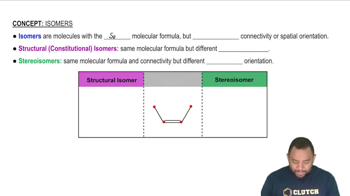
Isomers are compounds that have the same molecular formula but different structural arrangements of atoms. This can lead to variations in physical and chemical properties. In the case of C₅H₁₂, there are several structural isomers, including straight-chain and branched forms, which must be accurately represented in condensed structural formulas.
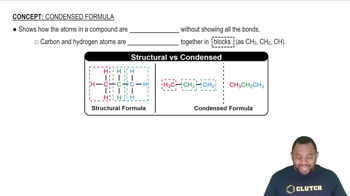
Condensed structures are a way of representing the molecular structure of a compound in a simplified format. They show the connectivity of atoms without depicting all the bonds explicitly. For example, in C₅H₁₂, a condensed structure might look like CH₃(CH₂)₃CH₃ for n-pentane, indicating the arrangement of carbon and hydrogen atoms.
The molecular formula C₅H₁₂ indicates that the compound contains five carbon atoms and twelve hydrogen atoms. This formula is characteristic of alkanes, which are saturated hydrocarbons. Understanding the implications of this formula is crucial for identifying the possible isomers and their respective structures.