Pearson+ LogoPearson+ Logo
Ch.19 Enzymes and Vitamins
McMurry - Fundamentals of GOB 8th Edition
McMurry8th EditionFundamentals of GOBISBN: 9780134015187Not the one you use?Change textbook
Chapter 19, Problem 39c

Name an enzyme that acts on each molecule.
c. RNA

Verified step by step guidance
1
Understand that enzymes are biological catalysts that speed up chemical reactions by acting on specific substrates. In this case, the substrate is RNA.
Recall that enzymes are named based on the type of reaction they catalyze or the substrate they act upon. For RNA, the enzyme typically involved is one that breaks down or modifies RNA molecules.
Identify that enzymes ending in '-ase' often indicate their function. For RNA, the enzyme responsible for breaking it down is called ribonuclease (commonly abbreviated as RNase).
Note that ribonucleases catalyze the hydrolysis of the phosphodiester bonds in RNA, breaking it into smaller components such as nucleotides.
Conclude that ribonuclease (RNase) is the enzyme that acts on RNA, facilitating its degradation or processing in biological systems.

Verified video answer for a similar problem:

This video solution was recommended by our tutors as helpful for the problem above.
Video duration:
1m
Was this helpful?

Key Concepts

Here are the essential concepts you must grasp in order to answer the question correctly.

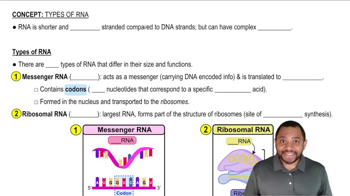
RNA

Ribonucleic acid (RNA) is a crucial molecule in the biology of cells, playing a central role in coding, decoding, regulation, and expression of genes. Unlike DNA, RNA is typically single-stranded and contains ribose sugar and the nitrogenous base uracil instead of thymine. RNA is involved in various cellular processes, including protein synthesis and gene regulation.
Recommended video:
Guided course
2:43
Types of RNA Concept 1

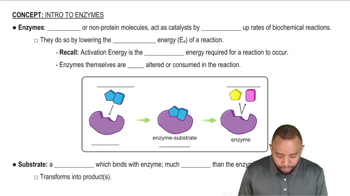
Enzymes

Enzymes are biological catalysts that accelerate chemical reactions in living organisms. They are typically proteins that lower the activation energy required for reactions, thus increasing the rate at which they occur. Each enzyme is specific to a particular substrate, meaning it acts on a specific molecule or type of molecule, facilitating various biochemical processes.
Recommended video:
Guided course
2:14
Intro to Enzymes Concept 1

RNA Polymerase

RNA polymerase is the enzyme responsible for synthesizing RNA from a DNA template during the process of transcription. It binds to the promoter region of a gene and unwinds the DNA strands, allowing it to read the sequence and construct a complementary RNA strand. This enzyme is essential for gene expression and the production of messenger RNA (mRNA), which carries genetic information to ribosomes for protein synthesis.
Recommended video:
Guided course
2:43
Types of RNA Concept 1