Nalorphine, a relative of morphine, is used to combat withdrawal symptoms in heroin users. How many milliliters of a 0.40% (m/v) solution of nalorphine must be injected to obtain a dose of 1.5 mg?
Ch.9 Solutions
McMurry8th EditionFundamentals of General, Organic, and Biological ChemistryISBN: 9780134015187Not the one you use?Change textbook
Chapter 9, Problem 60b
Sodium thiosulfate (Na2S2O3) the major component in photographic fixer solution, reacts with silver bromide to dissolve it according to the following reaction:
AgBr(s) + 2 Na2S2O3(aq) → Na3Ag(S2O3)2(aq) + NaBr(aq)
b. How many mL of 0.02 M Na2S2O3 contain this number of moles?
Verified step by step guidance1
Step 1: Start by identifying the number of moles of sodium thiosulfate (Na₂S₂O₃) required. This information should be given or calculated from part (a) of the problem. If not provided, refer to the stoichiometry of the reaction to determine the moles of Na₂S₂O₃ needed.
Step 2: Recall the formula for molarity (M), which is defined as the number of moles of solute divided by the volume of solution in liters: , where is the number of moles and is the volume in liters.
Step 3: Rearrange the formula to solve for the volume of the solution: . Here, is the volume in liters, is the number of moles of Na₂S₂O₃, and is the molarity of the solution (0.02 M in this case).
Step 4: Substitute the known values into the formula. Use the number of moles of Na₂S₂O₃ from Step 1 and the molarity of 0.02 M to calculate the volume in liters.
Step 5: Convert the volume from liters to milliliters by multiplying by 1000, since 1 liter = 1000 milliliters. This will give you the final volume of the 0.02 M Na₂S₂O₃ solution required to contain the given number of moles.

Verified video answer for a similar problem:
This video solution was recommended by our tutors as helpful for the problem above.
Video duration:
1mWas this helpful?
Key Concepts
Here are the essential concepts you must grasp in order to answer the question correctly.
Stoichiometry
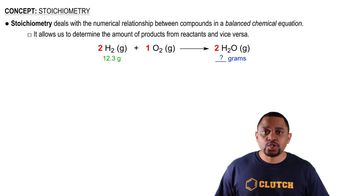
Stoichiometry is the branch of chemistry that deals with the quantitative relationships between the reactants and products in a chemical reaction. It allows us to calculate the amount of substances consumed and produced in a reaction based on balanced chemical equations. Understanding stoichiometry is essential for determining how many moles of a reactant are needed to react with a given amount of another substance.
Recommended video:
Guided course
Stoichiometry
Molarity
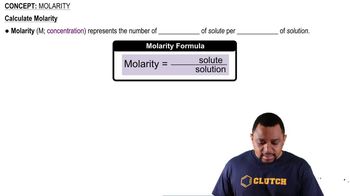
Molarity is a measure of concentration defined as the number of moles of solute per liter of solution. It is expressed in moles per liter (M) and is crucial for calculating how much of a substance is present in a given volume of solution. In this context, knowing the molarity of sodium thiosulfate allows us to determine the volume required to achieve a specific number of moles.
Recommended video:
Guided course
Molarity
Chemical Reaction
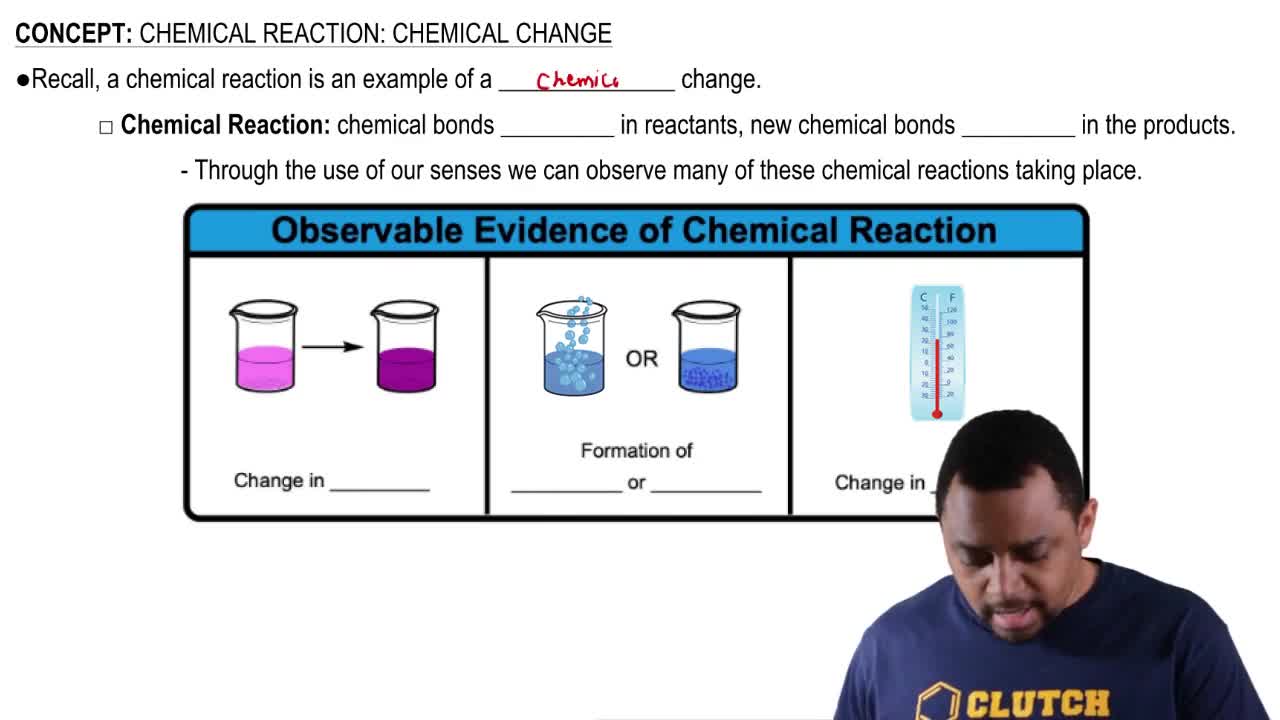
A chemical reaction involves the transformation of reactants into products through the breaking and forming of chemical bonds. The reaction provided shows how sodium thiosulfate interacts with silver bromide to form a complex and sodium bromide. Understanding the specifics of this reaction, including the stoichiometric coefficients, is vital for calculating the amounts of reactants needed.
Recommended video:
Guided course
Chemical Reaction: Chemical Change Concept 1
Related Practice
Textbook Question
1113
views
Textbook Question
If you had only 23 g of KOH remaining in a bottle, how many milliliters of 10.0% (m/v) solution could you prepare? How many milliliters of 0.25 M solution?
2296
views
Textbook Question
An aqueous solution that contains 285 ppm of potassium nitrate (KNO3) is being used to feed plants in a garden. What volume of this solution is needed to prepare 2.0 L of a solution that is 75 ppm in KNO3?
1758
views
Textbook Question
What is an electrolyte?
3021
views
Textbook Question
What is the concentration of a NaCl solution, in (m/v)%, prepared by diluting 65 mL of a saturated solution, which has a concentration of 37 (m/v)%, to 480 mL?
2705
views
Textbook Question
How many moles of each substance are needed to prepare the following solutions?
a. 50.0 mL of 8.0% (m/v) KCl (MW = 74.55 g/mol)
b. 200.0 mL of 7.5% (m/v) acetic acid (MW = 60.05 g/mol)
967
views