Back

Density definitions

Control buttons has been changed to "navigation" mode.
1/14
  • Density

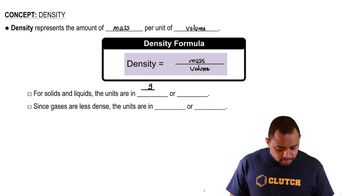
    A measure comparing the amount of matter to the space it occupies, calculated by dividing mass by volume.
  • Mass

    A quantity representing the amount of matter in a substance, commonly measured in grams for density calculations.
  • Volume

    A measure of the space an object or substance occupies, often expressed in milliliters, centimeters cubed, or liters.
  • Solids

    A phase of matter characterized by closely packed particles, typically exhibiting higher density than liquids or gases.
  • Liquids

    A phase of matter with particles less tightly packed than solids, generally more dense than gases.
  • Gases

    A phase of matter with widely spaced particles, resulting in much lower density compared to solids and liquids.
  • Grams

    A metric unit used to quantify mass, commonly applied in density measurements for all phases of matter.
  • Milliliters

    A metric unit for measuring volume, interchangeable with centimeters cubed when calculating density for liquids and solids.
  • Centimeters Cubed

    A unit of volume equal to one milliliter, often used for solids and liquids in density calculations.
  • Liters

    A metric unit for measuring larger volumes, typically used for gases in density calculations.
  • Decimeters Cubed

    A unit of volume equivalent to one liter, used for expressing the volume of gases in density contexts.
  • Conversion Factors

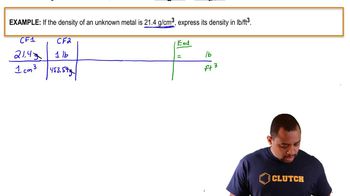
    Numerical relationships that allow switching between units, such as milliliters to centimeters cubed or liters to decimeters cubed.
  • Phase of Matter

    A classification describing the physical state—solid, liquid, or gas—affecting density and unit selection.
  • Formula

    A mathematical expression, such as mass divided by volume, used to calculate a property like density.