Pearson+ LogoPearson+ Logo
Ch.10 Proteins Workers of the Cell
Frost - General, Organic and Biological Chemistry 4th Edition
Frost4th EditionGeneral, Organic and Biological ChemistryISBN: 9780134988696Not the one you use?Change textbook
Chapter 6, Problem 92b

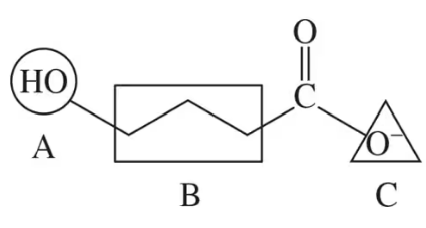
A substrate is held in the active site of an enzyme by attractive forces between the substrate and the amino acid side chains. For the outlined regions A, B, and C on the following substrate molecule:
Diagram showing a substrate molecule with labeled regions A, B, and C, illustrating enzyme-substrate interactions.
b. Could the amino acids serine, lysine, or glutamate be present in the active site? Support your answer.

Verified step by step guidance
1
Step 1: Understand the problem by identifying the substrate regions (A, B, and C) and the amino acids mentioned (serine, lysine, and glutamate). Recognize that the question is asking whether these amino acids could interact with the substrate in the enzyme's active site.
Step 2: Recall the chemical properties of the amino acids: Serine has a polar hydroxyl (-OH) group, lysine has a positively charged amine group (-NH3+), and glutamate has a negatively charged carboxylate group (-COO-). These properties determine the types of interactions they can form.
Step 3: Consider the types of attractive forces that can occur between the substrate and the amino acid side chains. These include hydrogen bonding, ionic interactions, and dipole-dipole interactions. Match the substrate's functional groups in regions A, B, and C with the amino acid side chains based on their chemical compatibility.
Step 4: Analyze each region of the substrate molecule (A, B, and C) to determine the functional groups present. For example, if region A contains a hydroxyl group, it could form hydrogen bonds with serine. If region B contains a negatively charged group, it could interact with lysine via ionic attraction. If region C contains a positively charged group, it could interact with glutamate via ionic attraction.
Step 5: Conclude whether serine, lysine, or glutamate could be present in the active site based on the compatibility of their side chains with the substrate's functional groups in regions A, B, and C. Support your answer by explaining the specific interactions that would occur.

Verified video answer for a similar problem:

This video solution was recommended by our tutors as helpful for the problem above.
Video duration:
3m
Was this helpful?

Key Concepts

Here are the essential concepts you must grasp in order to answer the question correctly.

Enzyme-Substrate Interaction

Enzymes are biological catalysts that speed up chemical reactions by binding to substrates at their active sites. The interaction between an enzyme and its substrate is primarily driven by non-covalent forces such as hydrogen bonds, ionic interactions, and hydrophobic effects. Understanding this interaction is crucial for determining how specific amino acids in the active site can influence substrate binding.
Recommended video:
Guided course
2:32
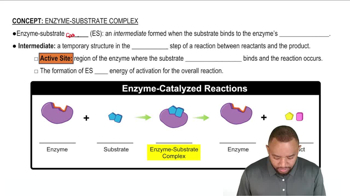
Enzyme-Substrate Complex Concept 1

Amino Acid Properties

Amino acids have distinct side chains that determine their chemical properties, such as polarity, charge, and size. For instance, serine is polar and can form hydrogen bonds, lysine is positively charged at physiological pH, and glutamate is negatively charged. These properties influence how these amino acids interact with substrates and other molecules in the active site of an enzyme.
Recommended video:
Guided course
3:03
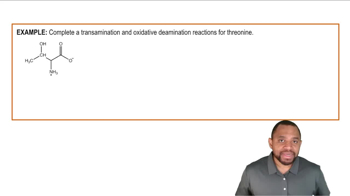
Amino Acid Catabolism: Amino Group Example 2

Active Site Specificity

The active site of an enzyme is specifically shaped to accommodate its substrate, allowing for precise interactions. The presence of certain amino acids in the active site can enhance or inhibit substrate binding based on their chemical properties. Evaluating whether serine, lysine, or glutamate could be present in the active site requires analyzing how their characteristics align with the substrate's structure and the nature of the interactions involved.
Recommended video:
Guided course
01:37
Specific Gravity