Pearson+ LogoPearson+ Logo
Ch.10 Proteins Workers of the Cell
Frost - General, Organic and Biological Chemistry 4th Edition
Frost4th EditionGeneral, Organic and Biological ChemistryISBN: 9780134988696Not the one you use?Change textbook
Chapter 6, Problem 84(2)

Match the terms (2) enzyme with the following descriptions:
a. has a tertiary structure that recognizes the substrate
b. is the combination of an enzyme with the substrate
c. has a structure that fits the active site of an enzyme

Verified step by step guidance
1
Step 1: Understand the key terms in the problem. An enzyme is a biological catalyst that speeds up chemical reactions in living organisms. It has a specific three-dimensional structure, including an active site where the substrate binds.
Step 2: Analyze description (a): 'has a tertiary structure that recognizes the substrate.' This refers to the enzyme itself, as its tertiary structure determines the shape of the active site, which is specific to the substrate.
Step 3: Analyze description (b): 'is the combination of an enzyme with the substrate.' This describes the enzyme-substrate complex, which forms when the substrate binds to the enzyme's active site.
Step 4: Analyze description (c): 'has a structure that fits the active site of an enzyme.' This refers to the substrate, which is the molecule that the enzyme acts upon and is specifically shaped to fit into the enzyme's active site.
Step 5: Match the terms to the descriptions: (a) corresponds to the enzyme, (b) corresponds to the enzyme-substrate complex, and (c) corresponds to the substrate.

Verified video answer for a similar problem:

This video solution was recommended by our tutors as helpful for the problem above.
Video duration:
4m
Was this helpful?

Key Concepts

Here are the essential concepts you must grasp in order to answer the question correctly.

Enzyme Structure

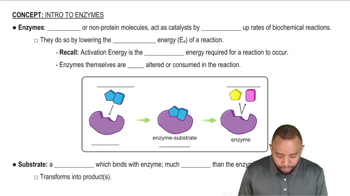
Enzymes are biological catalysts that speed up chemical reactions in living organisms. They have a specific three-dimensional structure, often described as having a tertiary structure, which is crucial for their function. This structure allows enzymes to recognize and bind to specific substrates, facilitating the conversion of substrates into products.
Recommended video:
Guided course
2:14
Intro to Enzymes Concept 1

Active Site

The active site of an enzyme is a specially shaped region that binds to the substrate. This site is complementary in shape to the substrate, allowing for a precise fit, much like a key fits into a lock. The interaction at the active site is essential for the enzyme's catalytic activity, as it lowers the activation energy required for the reaction.
Recommended video:
Guided course
1:06
Factors Affecting Enzyme Activity Concept 1

Enzyme-Substrate Complex

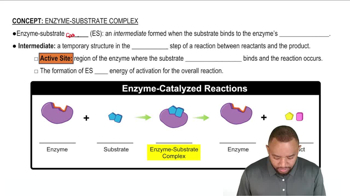
The enzyme-substrate complex is formed when an enzyme binds to its substrate at the active site. This temporary complex is crucial for the catalytic process, as it stabilizes the transition state and facilitates the conversion of substrates into products. Understanding this concept is key to grasping how enzymes function in biochemical reactions.
Recommended video:
Guided course
2:32
Enzyme-Substrate Complex Concept 1