Pearson+ LogoPearson+ Logo
Ch.10 Proteins Workers of the Cell
Frost - General, Organic and Biological Chemistry 4th Edition
Frost4th EditionGeneral, Organic and Biological ChemistryISBN: 9780134988696Not the one you use?Change textbook
Chapter 6, Problem 35a

Identify each of the following statements as characteristic of protein denaturation or protein hydrolysis. 
a. Milk curdles when lemon juice is added to it.

Verified step by step guidance
1
Understand the two processes: Protein denaturation involves the disruption of the protein's secondary, tertiary, or quaternary structure without breaking peptide bonds, while protein hydrolysis involves breaking the peptide bonds, resulting in smaller peptides or amino acids.
Analyze the given scenario: Milk curdling when lemon juice is added involves a change in the protein structure due to the acidic environment created by the lemon juice.
Recognize that the acidic environment disrupts the non-covalent interactions (e.g., hydrogen bonds, ionic bonds) and causes the proteins (like casein in milk) to unfold and aggregate.
Conclude that this process is an example of protein denaturation because the protein's structure is altered without breaking the peptide bonds.
Classify the statement: The curdling of milk when lemon juice is added is characteristic of protein denaturation.

Verified video answer for a similar problem:

This video solution was recommended by our tutors as helpful for the problem above.
Video duration:
45s
Was this helpful?

Key Concepts

Here are the essential concepts you must grasp in order to answer the question correctly.

Protein Denaturation

Protein denaturation refers to the structural alteration of proteins, where they lose their native conformation due to external factors like heat, pH changes, or chemical agents. This process disrupts the non-covalent interactions that maintain the protein's shape, leading to a loss of biological function. An example is the curdling of milk when acid, such as lemon juice, is added, causing the proteins to unfold and aggregate.
Recommended video:
Guided course
1:17
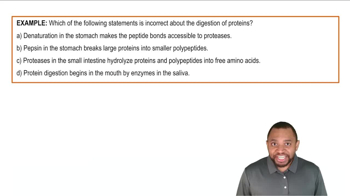
Digestion of Proteins Example 1

Protein Hydrolysis

Protein hydrolysis is a biochemical process that involves the breakdown of proteins into smaller peptides or amino acids through the addition of water. This reaction is typically catalyzed by enzymes or acids and is essential for digestion and metabolism. Unlike denaturation, hydrolysis results in the cleavage of peptide bonds, fundamentally altering the protein's structure and function.
Recommended video:
Guided course
1:12
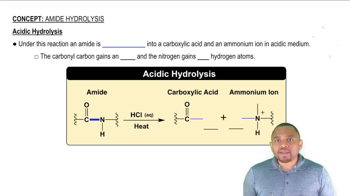
Acidic Hydrolysis Concept 1

pH and Protein Behavior

The pH level of a solution significantly influences protein behavior, affecting their solubility and stability. Proteins have specific pH ranges where they maintain their structure and function, known as the isoelectric point. When the pH deviates from this range, proteins can denature, as seen when lemon juice lowers the pH of milk, leading to curdling due to protein denaturation.
Recommended video:
Guided course
02:09
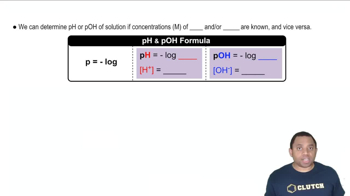
pH and pOH Calculations