Pearson+ LogoPearson+ Logo
Ch.10 Proteins Workers of the Cell
Frost - General, Organic and Biological Chemistry 4th Edition
Frost4th EditionGeneral, Organic and Biological ChemistryISBN: 9780134988696Not the one you use?Change textbook
Chapter 6, Problem 42

What is the name given to the reactant of an enzyme-catalyzed reaction?

Verified step by step guidance
1
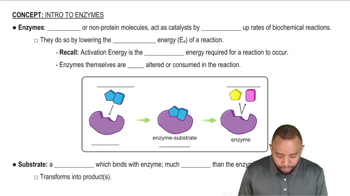
Understand that enzymes are biological catalysts that speed up chemical reactions without being consumed in the process.
Learn that the reactant in an enzyme-catalyzed reaction is specifically referred to as the 'substrate.'
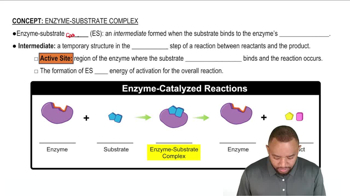
Recognize that the substrate binds to the enzyme's active site, forming an enzyme-substrate complex.
Note that the enzyme facilitates the conversion of the substrate into the product(s) of the reaction.
Remember that the term 'substrate' is used exclusively for the reactant in enzyme-catalyzed reactions, distinguishing it from general reactants in non-enzyme reactions.

Verified video answer for a similar problem:

This video solution was recommended by our tutors as helpful for the problem above.
Video duration:
3m
Was this helpful?

Key Concepts

Here are the essential concepts you must grasp in order to answer the question correctly.

Enzyme

An enzyme is a biological catalyst that accelerates chemical reactions in living organisms. It lowers the activation energy required for a reaction to occur, allowing processes to happen more efficiently and at lower temperatures. Enzymes are typically proteins and are highly specific to their substrates.
Recommended video:
Guided course
2:14
Intro to Enzymes Concept 1

Substrate

The substrate is the specific reactant molecule upon which an enzyme acts. In an enzyme-catalyzed reaction, the substrate binds to the enzyme's active site, forming an enzyme-substrate complex. This interaction facilitates the conversion of the substrate into products, which are then released from the enzyme.
Recommended video:
Guided course
2:32
Enzyme-Substrate Complex Concept 1

Active Site

The active site is a unique region on the enzyme where the substrate binds. It is typically a small pocket or groove on the enzyme's surface, shaped to fit the substrate precisely. The structure and chemical environment of the active site are crucial for the enzyme's specificity and catalytic activity.
Recommended video:
Guided course
1:06
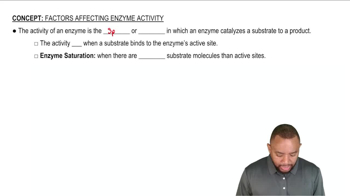
Factors Affecting Enzyme Activity Concept 1