Pearson+ LogoPearson+ Logo
Ch.11 Nucleic Acids Big Molecules with a Big Role
Frost - General, Organic and Biological Chemistry 4th Edition
Frost4th EditionGeneral, Organic and Biological ChemistryISBN: 9780134988696Not the one you use?Change textbook
Chapter 7, Problem 77a

A base substitution for an enzyme replaces leucine (a nonpolar amino acid) with alanine. Why does this change in amino acids have little effect on the biological activity of the enzyme?

Verified step by step guidance
1
Understand the nature of the amino acids involved: Leucine and alanine are both nonpolar amino acids, meaning they share similar chemical properties and hydrophobic characteristics.
Recognize the role of nonpolar amino acids in protein structure: Nonpolar amino acids typically reside in the interior of proteins, contributing to the hydrophobic core that stabilizes the protein's three-dimensional structure.
Consider the substitution's impact on enzyme structure: Since both leucine and alanine are nonpolar, replacing one with the other is unlikely to disrupt the hydrophobic interactions or the overall folding of the enzyme.
Evaluate the enzyme's active site: If the substitution does not occur in the active site or a region critical for substrate binding or catalysis, the enzyme's biological activity is likely unaffected.
Conclude why the substitution has little effect: The similarity in chemical properties between leucine and alanine ensures that the enzyme's structure and function remain largely intact, preserving its biological activity.

Verified video answer for a similar problem:

This video solution was recommended by our tutors as helpful for the problem above.
Video duration:
2m
Was this helpful?

Key Concepts

Here are the essential concepts you must grasp in order to answer the question correctly.

Amino Acid Properties

Amino acids have distinct properties based on their side chains, which can be polar, nonpolar, acidic, or basic. Leucine is a nonpolar amino acid, while alanine is also nonpolar but smaller in size. The similar nonpolar characteristics of both amino acids mean that their substitution may not significantly alter the enzyme's structure or function.
Recommended video:
Guided course
3:03
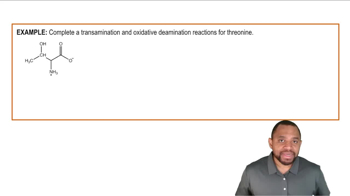
Amino Acid Catabolism: Amino Group Example 2

Enzyme Structure and Function

Enzymes are proteins that catalyze biochemical reactions, and their activity is largely determined by their three-dimensional structure. The active site of an enzyme, where substrate binding occurs, can often tolerate minor changes in amino acid composition, especially if the overall shape and charge distribution remain intact.
Recommended video:
Guided course
02:16
Logarithmic Functions

Redundancy in Genetic Code

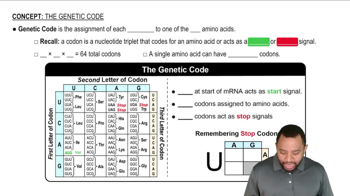
The genetic code is degenerate, meaning that multiple codons can code for the same amino acid. This redundancy allows for some mutations, such as base substitutions, to have little to no effect on the resulting protein. In this case, the substitution of leucine with alanine may not disrupt the enzyme's function due to the similar properties of these amino acids.
Recommended video:
Guided course
03:25
The Genetic Code Concept 1