Pearson+ LogoPearson+ Logo
Ch.11 Nucleic Acids Big Molecules with a Big Role
Frost - General, Organic and Biological Chemistry 4th Edition
Frost4th EditionGeneral, Organic and Biological ChemistryISBN: 9780134988696Not the one you use?Change textbook
Chapter 7, Problem 10b

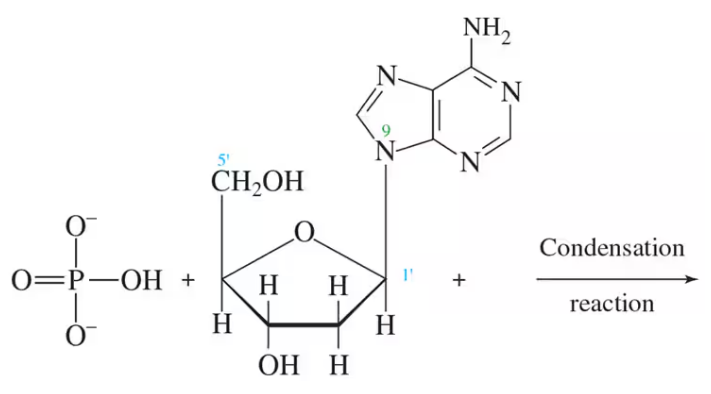
Provide the products for each of the following condensation reactions:
b. Chemical structures illustrating the condensation reaction of nucleoside and nucleotide formation.

Verified step by step guidance
1
Identify the type of condensation reaction taking place (e.g., esterification, aldol condensation, etc.) based on the reactants provided in the image.
Examine the functional groups of the reactants. For example, in esterification, an alcohol reacts with a carboxylic acid to form an ester and water.
Write the general reaction formula for the identified condensation reaction. For esterification: RCOOH + R'OHRCOOR' + H2O.
Determine the specific products by substituting the reactant groups (R and R') from the image into the general formula. Ensure the correct placement of functional groups in the product structure.
Verify the reaction mechanism and confirm that the products are consistent with the type of condensation reaction described.

Verified video answer for a similar problem:

This video solution was recommended by our tutors as helpful for the problem above.
Video duration:
1m
Was this helpful?

Key Concepts

Here are the essential concepts you must grasp in order to answer the question correctly.

Condensation Reaction

A condensation reaction is a chemical process where two molecules combine to form a larger molecule, typically with the loss of a small molecule such as water. This type of reaction is fundamental in organic chemistry, particularly in the formation of polymers and larger organic compounds. Understanding the mechanism of condensation reactions is crucial for predicting the products formed in such reactions.
Recommended video:
Guided course
1:53
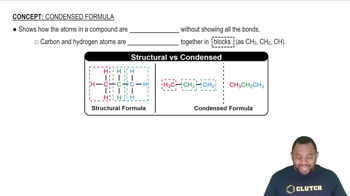
Condensed Formula Concept 1

Functional Groups

Functional groups are specific groups of atoms within molecules that are responsible for the characteristic chemical reactions of those molecules. In condensation reactions, the presence of certain functional groups, such as alcohols, amines, or carboxylic acids, can significantly influence the reaction pathway and the products formed. Identifying these groups is essential for determining the outcome of the reaction.
Recommended video:
Guided course
1:11
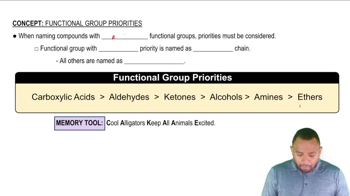
Functional Group Priorities Concept 1

Reaction Mechanism

A reaction mechanism describes the step-by-step sequence of elementary reactions by which overall chemical change occurs. In condensation reactions, understanding the mechanism helps in predicting the formation of products and intermediates. This knowledge is vital for chemists to manipulate conditions to favor desired products in synthetic pathways.
Recommended video:
Guided course
1:30
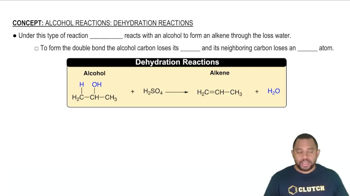
Alcohol Reactions: Dehydration Reactions Concept 1