Pearson+ LogoPearson+ Logo
Ch.12 Food as Fuel An Overview of Metabolism
Frost - General, Organic and Biological Chemistry 4th Edition
Frost4th EditionGeneral, Organic and Biological ChemistryISBN: 9780134988696Not the one you use?Change textbook
Chapter 8, Problem 28

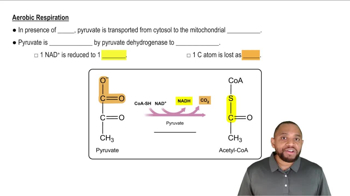
Name the coenzyme produced during the conversion of pyruvate to acetyl CoA.

Verified step by step guidance
1
Understand the context: The conversion of pyruvate to acetyl CoA is a key step in cellular respiration, specifically in the link reaction between glycolysis and the citric acid cycle.
Identify the chemical process: During this reaction, pyruvate undergoes oxidative decarboxylation, which involves the removal of a carbon atom as carbon dioxide (CO2).
Recognize the role of coenzymes: Coenzymes are molecules that assist enzymes in catalyzing reactions. In this process, a coenzyme is reduced as electrons are transferred.
Determine the specific coenzyme involved: The coenzyme that is reduced during this reaction is NAD+, which becomes NADH as it accepts electrons and a hydrogen ion.
Conclude the naming: The coenzyme produced during the conversion of pyruvate to acetyl CoA is NADH, which plays a crucial role in carrying electrons to the electron transport chain.

Verified video answer for a similar problem:

This video solution was recommended by our tutors as helpful for the problem above.
Video duration:
3m
Was this helpful?

Key Concepts

Here are the essential concepts you must grasp in order to answer the question correctly.

Pyruvate Decarboxylation

Pyruvate decarboxylation is the process by which pyruvate, derived from glycolysis, is converted into acetyl CoA. This reaction occurs in the mitochondria and involves the removal of a carbon atom from pyruvate, releasing it as carbon dioxide. This step is crucial for linking glycolysis to the citric acid cycle.
Recommended video:
Guided course
1:38
Pyruvate Oxidation Concept 2

Coenzyme A (CoA)

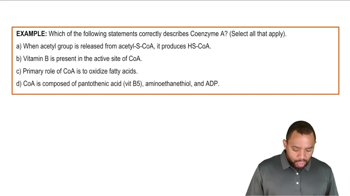
Coenzyme A (CoA) is a vital coenzyme that plays a key role in the metabolism of fatty acids and the citric acid cycle. It acts as a carrier of acyl groups, facilitating the transfer of acetyl groups to various metabolic pathways. In the conversion of pyruvate to acetyl CoA, CoA is essential for the formation of acetyl CoA from the decarboxylated pyruvate.
Recommended video:
Guided course
1:10
Coenzyme A Example 4

NAD+ and NADH

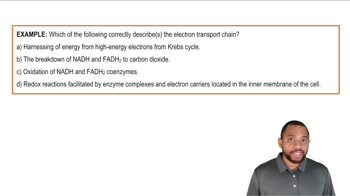
NAD+ (nicotinamide adenine dinucleotide) is a coenzyme that functions as an electron carrier in various metabolic reactions, including the conversion of pyruvate to acetyl CoA. During this process, NAD+ is reduced to NADH, capturing high-energy electrons. This conversion is crucial for energy production and is a key step in cellular respiration.
Recommended video:
Guided course
1:43
Intro to Electron Transport Chain Example 1