Pearson+ LogoPearson+ Logo
Ch.12 Food as Fuel An Overview of Metabolism
Frost - General, Organic and Biological Chemistry 4th Edition
Frost4th EditionGeneral, Organic and Biological ChemistryISBN: 9780134988696Not the one you use?Change textbook
Chapter 8, Problem 35

Name the reactions in the citric acid cycle that involve oxidative decarboxylation.

Verified step by step guidance
1
Step 1: Understand the term 'oxidative decarboxylation'. This refers to a chemical reaction where a molecule is oxidized (loses electrons) and a carboxyl group (-COOH) is removed as carbon dioxide (CO₂). These reactions are key steps in metabolic pathways like the citric acid cycle.
Step 2: Recall the citric acid cycle (also known as the Krebs cycle or TCA cycle). It is a series of enzymatic reactions that occur in the mitochondria, playing a central role in cellular respiration by oxidizing acetyl-CoA to CO₂ and generating energy-rich molecules like NADH and FADH₂.
Step 3: Identify the specific reactions in the citric acid cycle that involve oxidative decarboxylation. These are the steps where both oxidation and the release of CO₂ occur. The two key reactions are: (1) the conversion of isocitrate to α-ketoglutarate, catalyzed by isocitrate dehydrogenase, and (2) the conversion of α-ketoglutarate to succinyl-CoA, catalyzed by α-ketoglutarate dehydrogenase.
Step 4: For the first reaction, isocitrate is oxidized to form oxalosuccinate, which then undergoes decarboxylation to produce α-ketoglutarate. This reaction also reduces NAD⁺ to NADH. The overall reaction can be written as: isocitrate + NAD+α-ketoglutarate + NADH+ + CO2.
Step 5: For the second reaction, α-ketoglutarate is oxidized and decarboxylated to form succinyl-CoA. This reaction also reduces NAD⁺ to NADH. The overall reaction can be written as: α-ketoglutarate + NAD+ + CoAsuccinyl-CoA + NADH+ + CO2.

Verified video answer for a similar problem:

This video solution was recommended by our tutors as helpful for the problem above.
Video duration:
2m
Was this helpful?

Key Concepts

Here are the essential concepts you must grasp in order to answer the question correctly.

Citric Acid Cycle

The citric acid cycle, also known as the Krebs cycle, is a series of chemical reactions used by all aerobic organisms to generate energy. It occurs in the mitochondria and involves the oxidation of acetyl-CoA to produce ATP, NADH, and FADH2, which are crucial for cellular respiration. Understanding this cycle is essential for identifying specific reactions, particularly those involving decarboxylation.
Recommended video:
Guided course
2:31
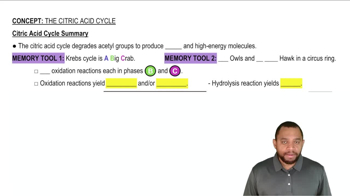
Citric Acid Cycle Summary Concept 12

Oxidative Decarboxylation

Oxidative decarboxylation is a biochemical process where a carboxyl group is removed from a molecule as carbon dioxide, coupled with the oxidation of the remaining molecule. In the context of the citric acid cycle, this process is vital for converting substrates into energy-rich compounds while releasing CO2 as a byproduct. It is a key step in the cycle that contributes to the overall energy yield.

Key Reactions in the Citric Acid Cycle

Within the citric acid cycle, specific reactions are classified as oxidative decarboxylation, notably the conversion of isocitrate to alpha-ketoglutarate and the conversion of alpha-ketoglutarate to succinyl-CoA. These reactions are catalyzed by isocitrate dehydrogenase and alpha-ketoglutarate dehydrogenase, respectively, and are crucial for the cycle's function, as they produce NADH and release CO2.
Recommended video:
Guided course
2:31
Citric Acid Cycle Summary Concept 12