Pearson+ LogoPearson+ Logo
Ch.12 Food as Fuel An Overview of Metabolism
Frost - General, Organic and Biological Chemistry 4th Edition
Frost4th EditionGeneral, Organic and Biological ChemistryISBN: 9780134988696Not the one you use?Change textbook
Chapter 8, Problem 44

Name the complex where FADH2 enters electron transport.

Verified step by step guidance
1
Understand that FADH₂ is a molecule involved in cellular respiration, specifically in the electron transport chain, which is part of oxidative phosphorylation.
Recall that the electron transport chain consists of a series of protein complexes embedded in the inner mitochondrial membrane, numbered I through IV.
Identify that FADH₂ donates electrons directly to Complex II (succinate dehydrogenase), bypassing Complex I, unlike NADH which donates electrons to Complex I.
Note that Complex II is unique because it is also part of the citric acid cycle, where it catalyzes the oxidation of succinate to fumarate while reducing FAD to FADH₂.
Conclude that the complex where FADH₂ enters the electron transport chain is Complex II (succinate dehydrogenase).

Verified video answer for a similar problem:

This video solution was recommended by our tutors as helpful for the problem above.
Video duration:
1m
Was this helpful?

Key Concepts

Here are the essential concepts you must grasp in order to answer the question correctly.

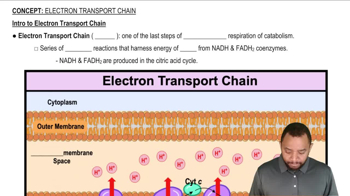
Electron Transport Chain (ETC)

The Electron Transport Chain is a series of protein complexes and other molecules located in the inner mitochondrial membrane. It plays a crucial role in cellular respiration by transferring electrons from electron donors like NADH and FADH₂ to electron acceptors, ultimately leading to the production of ATP through oxidative phosphorylation.
Recommended video:
Guided course
3:10
Intro to Electron Transport Chain Concept 1

FADH₂

FADH₂ is a reduced form of flavin adenine dinucleotide, a coenzyme involved in various metabolic reactions. It is produced during the Krebs cycle and serves as an electron carrier in the Electron Transport Chain, contributing to ATP synthesis by donating electrons to Complex II of the ETC.
Recommended video:
Guided course
1:43
Intro to Electron Transport Chain Example 1

Complex II (Succinate Dehydrogenase)

Complex II, also known as succinate dehydrogenase, is one of the four main protein complexes in the Electron Transport Chain. It is responsible for the oxidation of succinate to fumarate in the Krebs cycle and facilitates the transfer of electrons from FADH₂ to ubiquinone, marking the entry point of FADH₂ into the ETC.
Recommended video:
Guided course
2:32
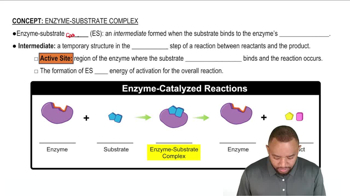
Enzyme-Substrate Complex Concept 1