Pearson+ LogoPearson+ Logo
Ch.12 Food as Fuel An Overview of Metabolism
Frost - General, Organic and Biological Chemistry 4th Edition
Frost4th EditionGeneral, Organic and Biological ChemistryISBN: 9780134988696Not the one you use?Change textbook
Chapter 8, Problem 11a

Identify the metabolic nucleotide described by the following:
a. exchanges energy when a phosphate bond is hydrolyzed

Verified step by step guidance
1
Understand the concept of metabolic nucleotides: These are molecules that play a key role in energy transfer within cells. They often contain phosphate groups that can be hydrolyzed to release energy.
Recall the structure of ATP (adenosine triphosphate): ATP is a nucleotide composed of an adenine base, a ribose sugar, and three phosphate groups. It is the primary energy currency of the cell.
Recognize the process of hydrolysis: When ATP undergoes hydrolysis, one of its phosphate bonds is broken, converting ATP to ADP (adenosine diphosphate) and releasing energy. This energy is used to drive various cellular processes.
Identify the key feature described in the problem: The nucleotide mentioned exchanges energy when a phosphate bond is hydrolyzed, which matches the function of ATP.
Conclude that the metabolic nucleotide described in the problem is ATP, as it is the molecule responsible for energy exchange through phosphate bond hydrolysis in metabolic processes.

Verified video answer for a similar problem:

This video solution was recommended by our tutors as helpful for the problem above.
Video duration:
3m
Was this helpful?

Key Concepts

Here are the essential concepts you must grasp in order to answer the question correctly.

Phosphate Bond Hydrolysis

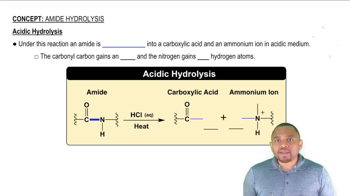
Phosphate bond hydrolysis refers to the chemical reaction where a phosphate group is removed from a nucleotide, releasing energy. This process is crucial in cellular metabolism, as it provides the energy needed for various biochemical reactions. The breaking of the high-energy phosphate bond in molecules like ATP (adenosine triphosphate) is a primary example of this mechanism.
Recommended video:
Guided course
1:12
Acidic Hydrolysis Concept 1

Adenosine Triphosphate (ATP)

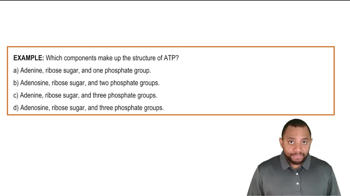
ATP, or adenosine triphosphate, is the primary energy carrier in all living organisms. It consists of an adenosine molecule bonded to three phosphate groups. When one of these phosphate bonds is hydrolyzed, ATP is converted to ADP (adenosine diphosphate) and inorganic phosphate, releasing energy that powers cellular processes such as muscle contraction and biochemical synthesis.
Recommended video:
Guided course
1:03
Adenosine Triphosphate (ATP) Example 2

Metabolic Nucleotides

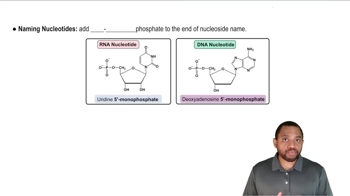
Metabolic nucleotides are organic molecules that play key roles in cellular metabolism, primarily as energy carriers or as building blocks for nucleic acids. They include ATP, GTP, and others, which are involved in energy transfer and signaling pathways. Understanding their function is essential for grasping how cells manage energy and carry out metabolic processes.
Recommended video:
Guided course
1:21
Naming Nucleosides and Nucleotides Concept 2