

Pearson+ LogoPearson+ Logo
Ch.7 States of Matter and Their Attractive Forces
Frost - General, Organic and Biological Chemistry 4th Edition
Frost4th EditionGeneral, Organic and Biological ChemistryISBN: 9780134988696Not the one you use?Change textbook
Chapter 4, Problem 42

Olive oil is a monounsaturated oil with a melting point of -6 °C. Soybean oil is a polyunsaturated oil with a melting point of -16 °C . Explain their difference in melting points.

Verified step by step guidance
1
insert step 1> Understand that the melting point of a substance is influenced by the structure and types of bonds present in the molecules.
insert step 2> Recognize that olive oil is a monounsaturated oil, meaning it contains fatty acids with one double bond in their hydrocarbon chains.
insert step 3> Note that soybean oil is a polyunsaturated oil, which means it contains fatty acids with more than one double bond in their hydrocarbon chains.
insert step 4> Explain that the presence of multiple double bonds in polyunsaturated oils like soybean oil causes kinks in the hydrocarbon chains, preventing them from packing closely together, which lowers the melting point.
insert step 5> Conclude that monounsaturated oils like olive oil have fewer kinks due to only one double bond, allowing for tighter packing of molecules, resulting in a higher melting point compared to polyunsaturated oils.

Verified video answer for a similar problem:

This video solution was recommended by our tutors as helpful for the problem above.
Video duration:
4m
Was this helpful?

Key Concepts

Here are the essential concepts you must grasp in order to answer the question correctly.

Fatty Acid Composition

The melting point of oils is significantly influenced by their fatty acid composition. Monounsaturated fats, like those in olive oil, contain one double bond in their fatty acid chains, which allows for a more compact structure, leading to a higher melting point. In contrast, polyunsaturated fats, such as those in soybean oil, have multiple double bonds, creating kinks in the fatty acid chains that prevent tight packing and result in a lower melting point.
Recommended video:
Guided course
2:00
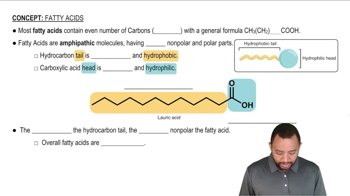
Fatty Acids Concept 1

Degree of Unsaturation

The degree of unsaturation refers to the number of double bonds present in the fatty acid chains of oils. Oils with higher degrees of unsaturation, like soybean oil, tend to remain liquid at lower temperatures due to the presence of multiple double bonds that disrupt the orderly packing of molecules. This contrasts with monounsaturated oils, which have fewer double bonds and thus a higher tendency to solidify at higher temperatures.
Recommended video:
Guided course
0:57
Saturated and Unsaturated Hydrocarbons Example 2

Physical Properties of Oils

The physical properties of oils, including their melting points, are determined by molecular structure and interactions. Factors such as the length of the fatty acid chains and the presence of double bonds affect how closely the molecules can pack together. This packing influences the oil's state at room temperature, with oils that can pack more tightly (like olive oil) having higher melting points compared to those that cannot (like soybean oil).
Recommended video:
Guided course
02:54
Physical Properties Concept