Pearson+ LogoPearson+ Logo
Ch.7 States of Matter and Their Attractive Forces
Frost - General, Organic and Biological Chemistry 4th Edition
Frost4th EditionGeneral, Organic and Biological ChemistryISBN: 9780134988696Not the one you use?Change textbook
Chapter 4, Problem 44

One of the main triglycerides in palm oil is tripalmitin. It contains three fatty acids with carbon designations of, [16:0]. Draw the structure of tripalmitin. Would you expect this molecule to be a solid or liquid at room temperature?

Verified step by step guidance
1
Understand the structure of tripalmitin: Tripalmitin is a triglyceride composed of glycerol and three palmitic acid molecules. Palmitic acid is a saturated fatty acid with the formula C16H32O2 (carbon designation [16:0], meaning 16 carbons and no double bonds).
Draw the glycerol backbone: Glycerol is a three-carbon molecule with hydroxyl groups (-OH) attached to each carbon. Represent this as CH2OH-CHOH-CH2OH.
Attach the fatty acids: Each hydroxyl group of glycerol reacts with the carboxyl group (-COOH) of palmitic acid to form an ester bond. Replace the -OH groups on glycerol with the palmitic acid chains, resulting in a structure where three palmitic acid chains are esterified to the glycerol backbone.
Analyze the physical state: Saturated fatty acids like palmitic acid have straight chains that allow tight packing. This tight packing increases intermolecular forces, such as van der Waals interactions, making tripalmitin likely to be a solid at room temperature.
Conclude the reasoning: Since tripalmitin contains only saturated fatty acids ([16:0]), its structure promotes tight packing and higher melting points, which supports the expectation that it is a solid at room temperature.

Verified video answer for a similar problem:

This video solution was recommended by our tutors as helpful for the problem above.
Video duration:
3m
Was this helpful?

Key Concepts

Here are the essential concepts you must grasp in order to answer the question correctly.

Triglycerides

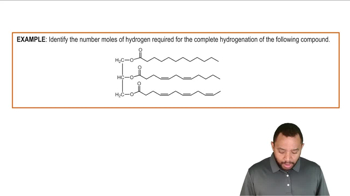
Triglycerides are a type of lipid formed from one glycerol molecule and three fatty acids. They serve as a major form of energy storage in the body and can be saturated or unsaturated, affecting their physical state. Saturated triglycerides, like tripalmitin, typically have higher melting points and are solid at room temperature.
Recommended video:
Guided course
0:57
Triacylglycerol Reactions: Hydrogenation Example 1

Fatty Acid Structure

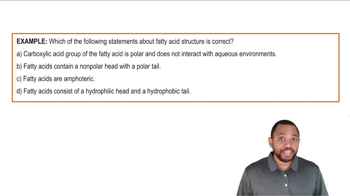
Fatty acids are long hydrocarbon chains with a carboxylic acid group at one end. The carbon designation, such as [16:0], indicates the number of carbon atoms and the number of double bonds present. In the case of tripalmitin, the '16:0' signifies that it has 16 carbon atoms and no double bonds, classifying it as a saturated fatty acid.
Recommended video:
Guided course
0:55
Fatty Acids Example 1

Physical State of Lipids

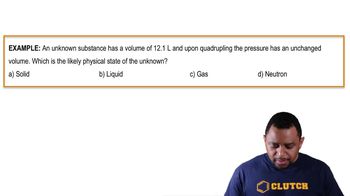
The physical state of lipids at room temperature is influenced by their saturation level. Saturated lipids, which have no double bonds, pack closely together, resulting in a solid state, while unsaturated lipids, with one or more double bonds, tend to be liquid. Therefore, tripalmitin, being a saturated triglyceride, is expected to be solid at room temperature.
Recommended video:
Guided course
01:01
States of Matter Example 1