Pearson+ LogoPearson+ Logo
Ch.10 Acids and Bases
McMurry - Fundamentals of GOB 8th Edition
McMurry8th EditionFundamentals of GOBISBN: 9780134015187Not the one you use?Change textbook
Chapter 10, Problem 88a

How many equivalents of an acid or base are in the following?
a. 0.25 mol Mg(OH)2

Verified step by step guidance
1
Identify the concept of equivalents: In acid-base chemistry, an equivalent is the amount of a substance that reacts with or supplies one mole of hydrogen ions (H⁺) or hydroxide ions (OH⁻). For bases, the number of equivalents is determined by the number of OH⁻ ions the base can release per mole.
Determine the chemical formula of the base: The given compound is magnesium hydroxide, Mg(OH)₂. Each formula unit of Mg(OH)₂ contains two hydroxide ions (OH⁻).
Calculate the number of equivalents per mole of Mg(OH)₂: Since each mole of Mg(OH)₂ releases 2 moles of OH⁻ ions, there are 2 equivalents of base per mole of Mg(OH)₂.
Multiply the number of moles of Mg(OH)₂ by the number of equivalents per mole: Use the relationship: \( \text{Equivalents} = \text{moles} \times \text{equivalents per mole} \). Substituting the given value, \( 0.25 \text{ mol Mg(OH)₂} \times 2 \text{ equivalents/mol} \).
Simplify the expression to find the total number of equivalents: Perform the multiplication to determine the total equivalents of the base present in 0.25 mol of Mg(OH)₂.

Verified video answer for a similar problem:

This video solution was recommended by our tutors as helpful for the problem above.
Video duration:
1m
Was this helpful?

Key Concepts

Here are the essential concepts you must grasp in order to answer the question correctly.

Equivalents in Acid-Base Chemistry

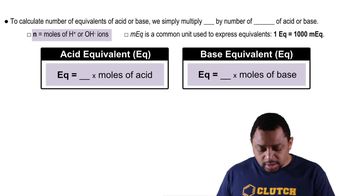
In acid-base chemistry, an equivalent refers to the amount of a substance that can donate or accept one mole of protons (H⁺ ions). For acids, this is often the number of protons they can donate, while for bases, it is the number of protons they can accept. Understanding equivalents is crucial for stoichiometric calculations in titrations and reactions involving acids and bases.
Recommended video:
Guided course
00:46
Acid-Base Equivalents Concept 2

Stoichiometry of Magnesium Hydroxide

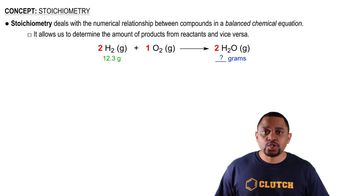
Magnesium hydroxide, Mg(OH)₂, is a strong base that dissociates in water to produce magnesium ions (Mg²⁺) and hydroxide ions (OH⁻). Each formula unit of Mg(OH)₂ can provide two hydroxide ions, which means it can neutralize two protons. This stoichiometric relationship is essential for calculating the number of equivalents present in a given amount of the compound.
Recommended video:
Guided course
01:16
Stoichiometry

Calculating Equivalents

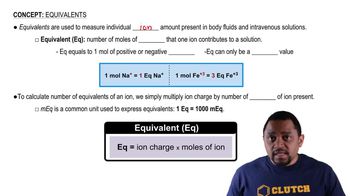
To calculate the number of equivalents of a substance, you multiply the number of moles by the number of reactive units per mole. For Mg(OH)₂, with 0.25 moles present and each mole providing two equivalents (due to two hydroxide ions), the calculation would be 0.25 moles × 2 equivalents/mole, resulting in 0.5 equivalents. This method is fundamental in determining the reactivity of acids and bases in various chemical reactions.
Recommended video:
Guided course
01:43
Equivalents Concept 1