How does normality compare to molarity for monoprotic and polyprotic acids?
Ch.10 Acids and Bases
Chapter 10, Problem 90
What are the molarity and the normality of a solution made by dissolving 5.0 g of Ca(OH)2 in enough water to make 500.0 mL of solution?
Verified step by step guidance1
Step 1: Calculate the molar mass of calcium hydroxide (Ca(OH)₂). The molar mass is determined by summing the atomic masses of all atoms in the compound: Ca = 40.08 g/mol, O = 16.00 g/mol, H = 1.008 g/mol. Therefore, the molar mass of Ca(OH)₂ is 40.08 + (2 × (16.00 + 1.008)) g/mol.
Step 2: Convert the given mass of Ca(OH)₂ (5.0 g) into moles using the formula: \( \text{moles} = \frac{\text{mass}}{\text{molar mass}} \). Substitute the values for mass and molar mass to find the number of moles of Ca(OH)₂.
Step 3: Calculate the molarity (M) of the solution using the formula: \( M = \frac{\text{moles of solute}}{\text{volume of solution in liters}} \). Convert the given volume of the solution (500.0 mL) into liters by dividing by 1000, then substitute the moles of Ca(OH)₂ and the volume in liters into the formula.
Step 4: Determine the normality (N) of the solution. For Ca(OH)₂, each molecule provides 2 hydroxide ions (OH⁻), so the equivalent factor is 2. Use the formula: \( N = M \times \text{equivalent factor} \). Multiply the molarity by the equivalent factor to find the normality.
Step 5: Summarize the results. The molarity represents the concentration of Ca(OH)₂ in moles per liter, while the normality accounts for the number of equivalents of hydroxide ions per liter of solution.

Verified video answer for a similar problem:
This video solution was recommended by our tutors as helpful for the problem above.
Video duration:
3mWas this helpful?
Key Concepts
Here are the essential concepts you must grasp in order to answer the question correctly.
Molarity
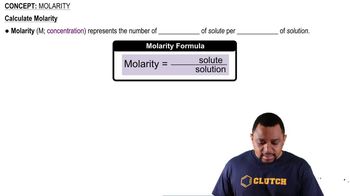
Molarity is a measure of concentration defined as the number of moles of solute per liter of solution. It is calculated using the formula M = moles of solute / liters of solution. In this case, to find the molarity of the Ca(OH)₂ solution, one must first convert the mass of the solute into moles using its molar mass and then divide by the volume of the solution in liters.
Recommended video:
Guided course
Molarity
Normality
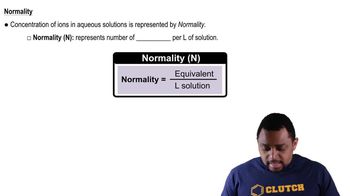
Normality is another measure of concentration that reflects the number of equivalents of a solute per liter of solution. It is particularly useful in acid-base reactions and redox reactions. For Ca(OH)₂, which can donate two hydroxide ions (OH⁻) per formula unit, the normality can be calculated by multiplying the molarity by the number of equivalents, which is determined by the number of reactive species in the solution.
Recommended video:
Guided course
Equivalents Concept 2
Molar Mass
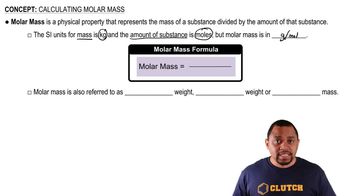
Molar mass is the mass of one mole of a substance, typically expressed in grams per mole (g/mol). It is essential for converting between grams and moles when calculating concentrations. For Ca(OH)₂, the molar mass is calculated by summing the atomic masses of calcium (Ca), oxygen (O), and hydrogen (H) in the compound, which is necessary to determine how many moles are present in the given mass of the solute.
Recommended video:
Guided course
Calculating Molar Mass
Related Practice
Textbook Question
1699
views
Textbook Question
Identify the number of equivalents per mole for each of the following acids and bases.
b. H3PO4
821
views
Textbook Question
How many equivalents of an acid or base are in the following?
a. 0.25 mol Mg(OH)2
868
views
Textbook Question
What are the molarity and the normality of a solution made by dissolving 25 g of citric acid (triprotic, C6H5O7H3) in enough water to make 800 mL of solution?
980
views
Textbook Question
A solution is prepared by bubbling 15.0 L of HCl(g) at 25 °C and 1 atm into 250.0 mL of water.
a. Assuming all the HCl dissolves in the water, how many moles of HCl are in solution?
2072
views
Textbook Question
The dissociation of water into H3O+ and OH– ions depends on temperature. At 0 °C the [H3O+] = 3.38 x 10⁻⁸ M, at 25 °C the [H3O+] = 1.00 x 10⁻⁷ M, and at 50 °C the [H3O+] = 2.34 x 10⁻⁷ M.
b. What is the value of Kw at 0 °C and 50 °C?
1737
views