Pearson+ LogoPearson+ Logo
Ch.10 Acids and Bases
McMurry - Fundamentals of GOB 8th Edition
McMurry8th EditionFundamentals of GOBISBN: 9780134015187Not the one you use?Change textbook
Chapter 10, Problem 91

What are the molarity and the normality of a solution made by dissolving 25 g of citric acid (triprotic, C6H5O7H3) in enough water to make 800 mL of solution?

Verified step by step guidance
1
Step 1: Calculate the molar mass of citric acid (C₆H₈O₇). Add the atomic masses of all the atoms in the formula: 6 carbons, 8 hydrogens, and 7 oxygens. Use the periodic table to find the atomic masses (C = 12.01 g/mol, H = 1.008 g/mol, O = 16.00 g/mol).
Step 2: Determine the number of moles of citric acid in the solution. Use the formula: \( \text{moles} = \frac{\text{mass (g)}}{\text{molar mass (g/mol)}} \). Substitute the given mass of citric acid (25 g) and the molar mass calculated in Step 1.
Step 3: Calculate the molarity (M) of the solution. Use the formula: \( M = \frac{\text{moles of solute}}{\text{volume of solution in liters}} \). Convert the given volume of solution (800 mL) to liters by dividing by 1000, then substitute the moles of citric acid from Step 2 and the volume in liters.
Step 4: Understand the concept of normality (N) for a triprotic acid. Normality is defined as \( N = M \times \text{number of acidic protons per molecule} \). Since citric acid is triprotic, it can donate 3 protons (H⁺) per molecule. Multiply the molarity calculated in Step 3 by 3 to find the normality.
Step 5: Summarize the results. The molarity represents the concentration of citric acid in moles per liter, while the normality accounts for the total number of equivalents of H⁺ ions per liter. Ensure all units are consistent and clearly labeled.

Verified video answer for a similar problem:

This video solution was recommended by our tutors as helpful for the problem above.
Video duration:
3m
Was this helpful?

Key Concepts

Here are the essential concepts you must grasp in order to answer the question correctly.

Molarity

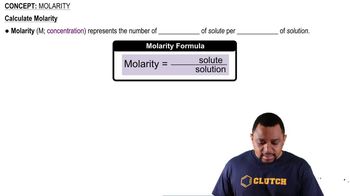
Molarity is a measure of concentration defined as the number of moles of solute per liter of solution. To calculate molarity, you first need to determine the number of moles of the solute, which can be found by dividing the mass of the solute by its molar mass. In this case, citric acid's molar mass is approximately 192.13 g/mol, and the volume of the solution is 0.8 L.
Recommended video:

Normality

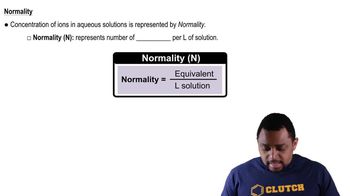
Normality is another measure of concentration that accounts for the reactive capacity of a solute in a solution. It is defined as the number of equivalents of solute per liter of solution. For citric acid, which is triprotic, each molecule can donate three protons (H⁺ ions), so the normality will be three times the molarity when calculating the equivalents based on the acid's ability to donate protons.
Recommended video:
Guided course
00:31
Equivalents Concept 2

Triprotic Acid

A triprotic acid is an acid that can donate three protons (H⁺ ions) per molecule in a solution. Citric acid (C₆H₅O₇H₃) is an example of a triprotic acid, which means that when calculating its normality, one must consider the total number of protons it can release. This characteristic is essential for determining the solution's acidity and its reactivity in various chemical reactions.
Recommended video: