Pearson+ LogoPearson+ Logo
Ch.10 Acids and Bases
McMurry - Fundamentals of GOB 8th Edition
McMurry8th EditionFundamentals of GOBISBN: 9780134015187Not the one you use?Change textbook
Chapter 10, Problem 84b

Identify the number of equivalents per mole for each of the following acids and bases.
b. H3PO4

Verified step by step guidance
1
Identify the definition of equivalents in the context of acids and bases. For acids, the number of equivalents per mole corresponds to the number of hydrogen ions (H⁺) the acid can donate per molecule.
Examine the chemical formula of the acid, H₃PO₄ (phosphoric acid). The subscript '3' in H₃ indicates that the molecule contains three hydrogen atoms that can potentially be donated as H⁺ ions.
Determine whether all three hydrogen atoms in H₃PO₄ are ionizable. In this case, H₃PO₄ is a triprotic acid, meaning it can donate up to three H⁺ ions per molecule in a stepwise manner.
Conclude that the number of equivalents per mole for H₃PO₄ is equal to the number of ionizable hydrogen atoms, which is 3.
To summarize, the number of equivalents per mole for H₃PO₄ is 3, as it can donate three H⁺ ions per molecule.

Verified video answer for a similar problem:

This video solution was recommended by our tutors as helpful for the problem above.
Video duration:
3m
Was this helpful?

Key Concepts

Here are the essential concepts you must grasp in order to answer the question correctly.

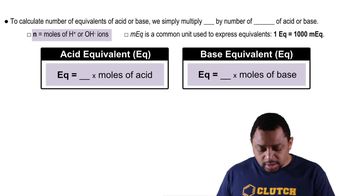
Equivalents in Acid-Base Chemistry

In acid-base chemistry, an equivalent refers to the amount of a substance that can donate or accept one mole of protons (H⁺ ions). For acids, the number of equivalents per mole is determined by the number of protons the acid can donate. This concept is crucial for understanding the strength and reactivity of acids and bases in various chemical reactions.
Recommended video:
Guided course
00:46
Acid-Base Equivalents Concept 2

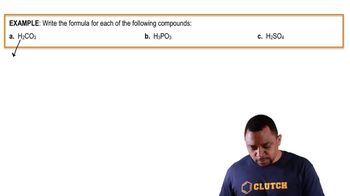
Phosphoric Acid (H₃PO₄)

Phosphoric acid (H₃PO₄) is a triprotic acid, meaning it can donate three protons (H⁺ ions) in solution. Each proton donation corresponds to one equivalent, so H₃PO₄ has three equivalents per mole. This property is important for calculating the acid's reactivity and its role in buffer solutions and other chemical processes.
Recommended video:
Guided course
02:42
Naming Acids Example 2

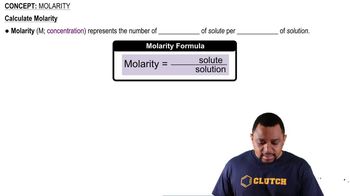
Molarity and Concentration

Molarity is a measure of concentration defined as the number of moles of solute per liter of solution. Understanding molarity is essential when discussing equivalents, as it allows for the calculation of how many equivalents of an acid or base are present in a given volume of solution. This concept is fundamental in titration and other quantitative chemical analyses.
Recommended video: