Pearson+ LogoPearson+ Logo
Ch.10 Acids and Bases
McMurry - Fundamentals of GOB 8th Edition
McMurry8th EditionFundamentals of GOBISBN: 9780134015187Not the one you use?Change textbook
Chapter 10, Problem 23

Show how ethylamine (C2H5NH2) reacts with hydrochloric acid to form an ethylammonium salt.

Verified step by step guidance
1
Step 1: Recognize that ethylamine (C₂H₅NH₂) is a weak base due to the presence of the amine group (-NH₂), which can accept a proton (H⁺). Hydrochloric acid (HCl) is a strong acid that donates a proton.
Step 2: Write the chemical equation for the reaction. Ethylamine reacts with hydrochloric acid to form ethylammonium chloride. The reaction can be represented as: C₂H₅NH₂ + HCl → C₂H₅NH₃⁺Cl⁻.
Step 3: Understand the mechanism of the reaction. The lone pair of electrons on the nitrogen atom in ethylamine attracts the proton (H⁺) from HCl, forming the ethylammonium ion (C₂H₅NH₃⁺). The chloride ion (Cl⁻) remains as the counterion.
Step 4: Note the product formed. The ethylammonium ion (C₂H₅NH₃⁺) is a positively charged species, and it pairs with the negatively charged chloride ion (Cl⁻) to form the ethylammonium salt (C₂H₅NH₃⁺Cl⁻).
Step 5: Verify the reaction's stoichiometry. Ensure that one mole of ethylamine reacts with one mole of hydrochloric acid to produce one mole of ethylammonium chloride, maintaining charge and mass balance.

Verified video answer for a similar problem:

This video solution was recommended by our tutors as helpful for the problem above.
Video duration:
1m
Was this helpful?

Key Concepts

Here are the essential concepts you must grasp in order to answer the question correctly.

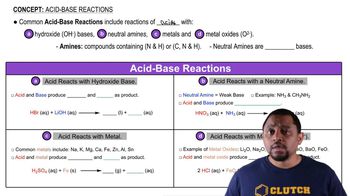
Acid-Base Reaction

An acid-base reaction involves the transfer of protons (H⁺ ions) from an acid to a base. In this case, hydrochloric acid (HCl) acts as the acid, donating a proton to ethylamine (C₂H₅NH₂), which acts as a base due to its nitrogen atom's lone pair. This reaction results in the formation of an ethylammonium ion (C₂H₅NH₃⁺) and chloride ion (Cl⁻).
Recommended video:
Guided course
03:08
Acid-Base Reactions Concept 1

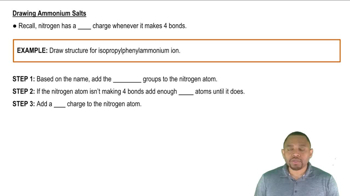
Formation of Ammonium Salts

When an amine like ethylamine reacts with an acid, it forms an ammonium salt. The ethylammonium ion produced in this reaction is a cation, while the chloride ion serves as the anion. This process is crucial in organic chemistry as it illustrates how amines can be converted into more stable, ionic forms, which are often more soluble in water.
Recommended video:
Guided course
1:04
Drawing Ammonium Salts Concept 2

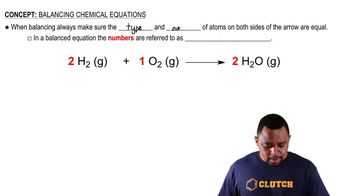
Chemical Equation Representation

The chemical equation for the reaction between ethylamine and hydrochloric acid can be represented as C₂H₅NH₂ + HCl → C₂H₅NH₃⁺ + Cl⁻. This notation succinctly captures the reactants and products, allowing for a clear understanding of the stoichiometry involved. Visual representations, such as reaction diagrams, further aid in comprehending the molecular interactions during the reaction.
Recommended video:
Guided course
01:32
Balancing Chemical Equations (Simplified) Concept 1