Pearson+ LogoPearson+ Logo
Ch.10 Acids and Bases
McMurry - Fundamentals of GOB 8th Edition
McMurry8th EditionFundamentals of GOBISBN: 9780134015187Not the one you use?Change textbook
Chapter 10, Problem 38

What happens when a strong acid such as HBr is dissolved in water?

Verified step by step guidance
1
When a strong acid like HBr is dissolved in water, it undergoes complete ionization. This means that every molecule of HBr dissociates into its constituent ions.
Write the chemical equation for the dissociation of HBr in water: HBr(aq)H(aq)+Br(aq). This shows that HBr dissociates into hydrogen ions (H⁺) and bromide ions (Br⁻).
The hydrogen ions (H⁺) released by the acid interact with water molecules to form hydronium ions (H₃O⁺). This can be represented as: H(aq)+H2O(l)H3O(aq).
Since HBr is a strong acid, the dissociation is essentially 100%, meaning no undissociated HBr molecules remain in the solution.
The resulting solution is highly acidic due to the high concentration of hydronium ions (H₃O⁺), which lowers the pH of the solution significantly.

Verified video answer for a similar problem:

This video solution was recommended by our tutors as helpful for the problem above.
Video duration:
2m
Was this helpful?

Key Concepts

Here are the essential concepts you must grasp in order to answer the question correctly.

Dissociation of Strong Acids

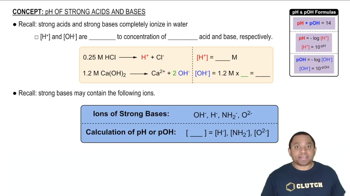
Strong acids, like HBr, completely dissociate in water, meaning they break apart into their constituent ions. For HBr, this results in the formation of hydrogen ions (H⁺) and bromide ions (Br⁻). This complete dissociation is a key characteristic of strong acids, distinguishing them from weak acids, which only partially dissociate.
Recommended video:
Guided course
02:39
Strong Acids and Bases

Ionization and pH

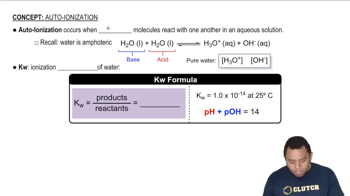
The ionization of strong acids in water significantly affects the pH of the solution. Since H⁺ ions increase the concentration of hydrogen ions in the solution, the pH decreases, indicating a more acidic environment. The pH scale ranges from 0 to 14, with values below 7 representing acidic solutions, and strong acids typically yield pH values close to 0.
Recommended video:
Guided course
02:22
Auto-Ionization and Kw

Conductivity of Electrolytes

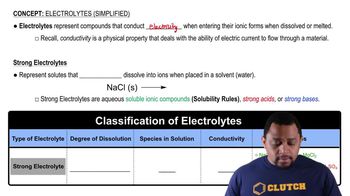
When HBr dissolves in water, it produces ions that enhance the solution's electrical conductivity. This property is due to the movement of charged particles (H⁺ and Br⁻) in the solution, which allows it to conduct electricity. Strong acids are classified as strong electrolytes because they fully dissociate, making them effective at conducting electrical current in aqueous solutions.
Recommended video:
Guided course
02:38
Electrolytes (Simplified) Concept 1