Pearson+ LogoPearson+ Logo
Ch.10 Acids and Bases
McMurry - Fundamentals of GOB 8th Edition
McMurry8th EditionFundamentals of GOBISBN: 9780134015187Not the one you use?Change textbook
Chapter 10, Problem 99b

The dissociation of water into H3O+ and OH ions depends on temperature. At 0 °C the [H3O+] = 3.38 x 10⁻⁸ M, at 25 °C the [H3O+] = 1.00 x 10⁻⁷ M, and at 50 °C the [H3O+] = 2.34 x 10⁻⁷ M.
b. What is the value of Kw at 0 °C and 50 °C?

Verified step by step guidance
1
Step 1: Recall the expression for the ionization constant of water, K_w, which is defined as the product of the concentrations of hydronium ions ([H₃O⁺]) and hydroxide ions ([OH⁻]). Mathematically, K_w = [H₃O⁺] × [OH⁻].
Step 2: Understand that water is neutral, meaning the concentrations of [H₃O⁺] and [OH⁻] are equal at any given temperature. Therefore, [OH⁻] = [H₃O⁺].
Step 3: Substitute the given values of [H₃O⁺] at 0 °C and 50 °C into the formula for K_w. For 0 °C, [H₃O⁺] = 3.38 × 10⁻⁸ M, so K_w = (3.38 × 10⁻⁸ M) × (3.38 × 10⁻⁸ M). For 50 °C, [H₃O⁺] = 2.34 × 10⁻⁷ M, so K_w = (2.34 × 10⁻⁷ M) × (2.34 × 10⁻⁷ M).
Step 4: Perform the multiplication for each temperature to find the value of K_w. For 0 °C, multiply (3.38 × 10⁻⁸) by itself. For 50 °C, multiply (2.34 × 10⁻⁷) by itself.
Step 5: Express the final values of K_w for both temperatures in scientific notation, ensuring the units are in M² (molar squared) since K_w is a product of two molar concentrations.

Verified video answer for a similar problem:

This video solution was recommended by our tutors as helpful for the problem above.
Video duration:
3m
Was this helpful?

Key Concepts

Here are the essential concepts you must grasp in order to answer the question correctly.

Dissociation of Water

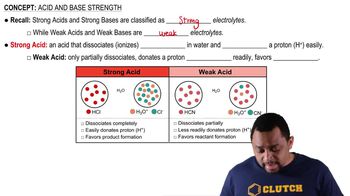
The dissociation of water refers to the process where water (H₂O) separates into hydronium ions (H₃O⁺) and hydroxide ions (OH⁻). This equilibrium is crucial for understanding acid-base chemistry and is influenced by temperature, as the concentrations of these ions change with thermal conditions.
Recommended video:
Guided course
02:06
Acid and Base Strength Concept 1

Ion Product of Water (K_w)

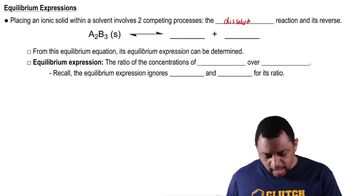
The ion product of water, denoted as K_w, is the equilibrium constant for the dissociation of water. It is defined as the product of the concentrations of H₃O⁺ and OH⁻ ions in pure water. K_w varies with temperature, and its value at 25 °C is 1.0 x 10⁻¹⁴, serving as a reference point for calculating ion concentrations at different temperatures.
Recommended video:
Guided course
01:37
Solubility Product Constant (Ksp) Concept 2

Temperature Dependence of K_w

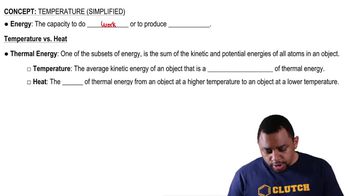
K_w is temperature-dependent, meaning its value changes with temperature variations. As temperature increases, the dissociation of water becomes more favorable, leading to higher concentrations of H₃O⁺ and OH⁻ ions, thus increasing K_w. Understanding this relationship is essential for calculating K_w at different temperatures, such as 0 °C and 50 °C.
Recommended video:
Guided course
01:30
Temperature (Simplified) Concept 1