Pearson+ LogoPearson+ Logo
Ch.10 Acids and Bases
McMurry - Fundamentals of GOB 8th Edition
McMurry8th EditionFundamentals of GOBISBN: 9780134015187Not the one you use?Change textbook
Chapter 10, Problem 40

What happens when a strong base such as KOH is dissolved in water?

Verified step by step guidance
1
When a strong base like KOH (potassium hydroxide) is dissolved in water, it dissociates completely into its constituent ions. This is because strong bases are highly soluble and ionize fully in aqueous solutions.
Write the dissociation equation for KOH in water: KOH(s) ightarrow K^+(aq) + OH^-(aq). This shows that KOH separates into potassium ions (K^+) and hydroxide ions (OH^−).
The hydroxide ions (OH^−) released into the solution increase the concentration of hydroxide ions, making the solution basic. The pH of the solution will be greater than 7.
The potassium ion (K^+) is a spectator ion, meaning it does not participate in the chemical reaction that determines the basicity of the solution. Its role is to balance the charge in the solution.
In summary, the dissolution of KOH in water results in a basic solution due to the production of hydroxide ions, which are responsible for the increase in pH.

Verified video answer for a similar problem:

This video solution was recommended by our tutors as helpful for the problem above.
Video duration:
2m
Was this helpful?

Key Concepts

Here are the essential concepts you must grasp in order to answer the question correctly.

Dissociation of Strong Bases

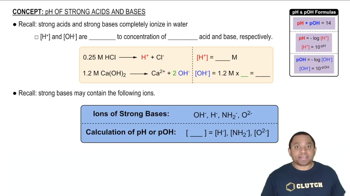
When a strong base like potassium hydroxide (KOH) is dissolved in water, it completely dissociates into its constituent ions. This means that KOH separates into potassium ions (K+) and hydroxide ions (OH-), which are free to move in the solution. This complete dissociation is a key characteristic of strong bases, distinguishing them from weak bases that only partially dissociate.
Recommended video:
Guided course
02:39
Strong Acids and Bases

pH and Basicity

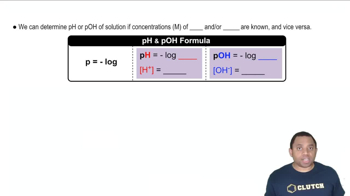
The pH scale measures the acidity or basicity of a solution, with values below 7 indicating acidity and values above 7 indicating basicity. When KOH dissolves in water, the concentration of hydroxide ions increases, resulting in a higher pH. This increase in pH signifies that the solution is basic, which can have various implications for chemical reactions and biological systems.
Recommended video:
Guided course
02:09
pH and pOH Calculations

Neutralization Reactions

Neutralization reactions occur when an acid and a base react to form water and a salt. The hydroxide ions from the dissolved KOH can react with hydrogen ions (H+) from an acid, effectively neutralizing the acid. This concept is fundamental in understanding how strong bases like KOH can be used in titrations and other chemical processes to control pH levels.
Recommended video:
Guided course
00:37
Lewis Dot Structures: Neutral Compounds (Simplified) Concept 1