Pearson+ LogoPearson+ Logo
Ch.10 Acids and Bases
McMurry - Fundamentals of GOB 8th Edition
McMurry8th EditionFundamentals of GOBISBN: 9780134015187Not the one you use?Change textbook
Chapter 10, Problem 42

What is the difference between a monoprotic acid and a diprotic acid? Give an example of each.

Verified step by step guidance
1
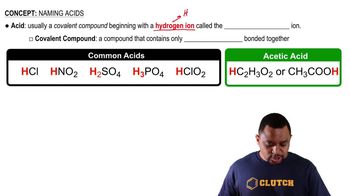
A monoprotic acid is an acid that can donate only one proton (H⁺) per molecule during a chemical reaction. For example, hydrochloric acid (HCl) is a monoprotic acid because it donates one H⁺ ion when dissolved in water.
A diprotic acid is an acid that can donate two protons (H⁺) per molecule during a chemical reaction, typically in two separate steps. For example, sulfuric acid (H₂SO₄) is a diprotic acid because it can donate two H⁺ ions sequentially.
To understand this concept, consider the dissociation of HCl in water: HCl → H⁺ + Cl⁻. This shows that HCl donates one proton, making it monoprotic.
For a diprotic acid like H₂SO₄, the dissociation occurs in two steps: (1) H₂SO₄ → H⁺ + HSO₄⁻, and (2) HSO₄⁻ → H⁺ + SO₄²⁻. This demonstrates the donation of two protons, one in each step.
In summary, the key difference is the number of protons the acid can donate: one for monoprotic acids and two for diprotic acids. Examples include HCl (monoprotic) and H₂SO₄ (diprotic).

Verified video answer for a similar problem:

This video solution was recommended by our tutors as helpful for the problem above.
Video duration:
2m
Was this helpful?

Key Concepts

Here are the essential concepts you must grasp in order to answer the question correctly.

Monoprotic Acid

A monoprotic acid is an acid that can donate only one proton (H⁺ ion) per molecule during the process of dissociation in an aqueous solution. This characteristic means that it has a single acidic hydrogen atom. A common example of a monoprotic acid is hydrochloric acid (HCl), which dissociates in water to release one proton.
Recommended video:

Diprotic Acid

A diprotic acid is an acid that can donate two protons (H⁺ ions) per molecule when it dissociates in solution. This means it has two acidic hydrogen atoms, allowing it to undergo two separate ionization steps. Sulfuric acid (H₂SO₄) is a well-known example of a diprotic acid, as it can release two protons in two stages of dissociation.
Recommended video:

Acid Dissociation

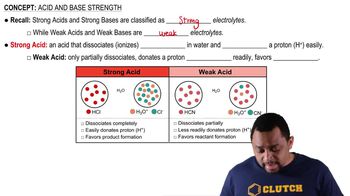
Acid dissociation refers to the process by which an acid releases protons into a solution, resulting in the formation of hydronium ions (H₃O⁺). The strength of an acid is often measured by its dissociation constant (Ka), which indicates how completely the acid ionizes in water. Understanding this concept is crucial for distinguishing between monoprotic and diprotic acids, as it highlights their differing capacities to donate protons.
Recommended video:
Guided course
02:06
Acid and Base Strength Concept 1