Pearson+ LogoPearson+ Logo
Ch.2 Atoms and the Periodic Table
McMurry - Fundamentals of GOB 8th Edition
McMurry8th EditionFundamentals of GOBISBN: 9780134015187Not the one you use?Change textbook
Chapter 2, Problem 51

Why does the fourth period in the periodic table contain 18 elements?

Verified step by step guidance
1
Understand the structure of the periodic table: The periodic table is organized based on the electron configuration of elements, which determines their chemical properties. Each period corresponds to the filling of a specific set of electron orbitals.
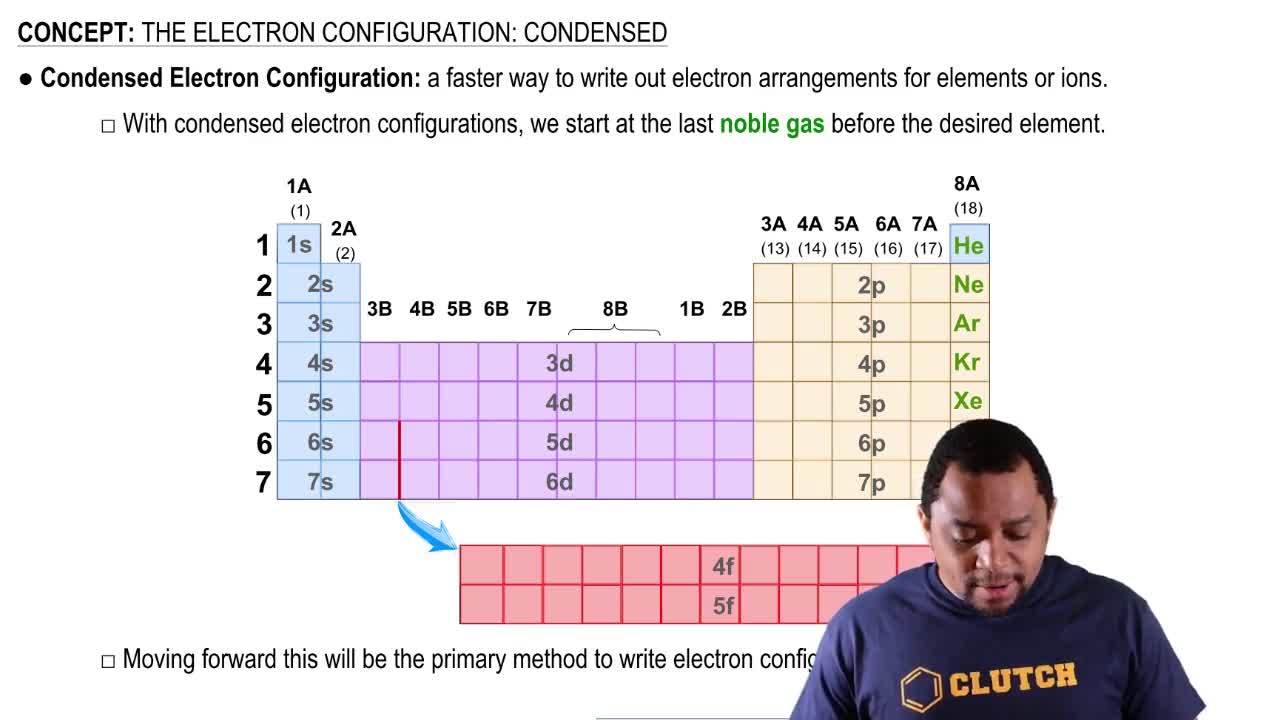
Recall the Aufbau principle: Electrons fill orbitals in order of increasing energy levels. The fourth period involves the filling of the 4s, 3d, and 4p orbitals.
Analyze the orbitals involved: The 4s orbital can hold 2 electrons, the 3d orbital can hold 10 electrons, and the 4p orbital can hold 6 electrons. Adding these together gives a total of 18 electrons.
Relate the electron configuration to the periodic table: Each element in the fourth period corresponds to the addition of one electron to these orbitals, starting with the 4s orbital, then the 3d orbital, and finally the 4p orbital.
Conclude why there are 18 elements: The fourth period contains 18 elements because it includes all the elements whose electrons fill the 4s, 3d, and 4p orbitals, resulting in a total of 18 positions in the period.

Verified video answer for a similar problem:

This video solution was recommended by our tutors as helpful for the problem above.
Video duration:
4m
Was this helpful?

Key Concepts

Here are the essential concepts you must grasp in order to answer the question correctly.

Periodic Table Structure

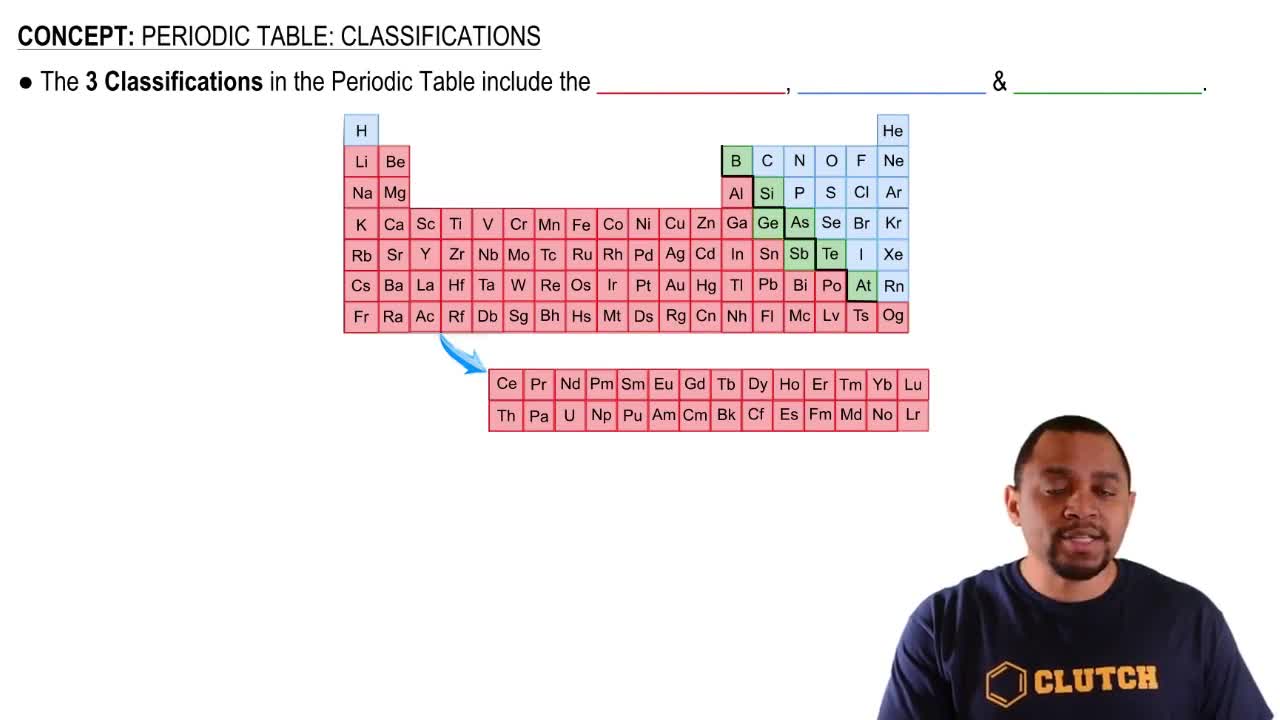
The periodic table is organized by increasing atomic number and groups elements with similar properties. Each period corresponds to the filling of electron shells, with the fourth period beginning when the 4s subshell is filled, followed by the 3d subshell. This structure helps explain the number of elements in each period.
Recommended video:
Guided course
02:40
Periodic Table: Classifications

Electron Configuration

Electron configuration describes the distribution of electrons in an atom's orbitals. In the fourth period, electrons fill the 4s and 3d orbitals, allowing for a total of 18 electrons (2 in 4s and 10 in 3d, plus 6 in 4p). This configuration is crucial for understanding the number of elements present in this period.
Recommended video:
Guided course
01:08
The Electron Configuration: Condensed

Transition Metals

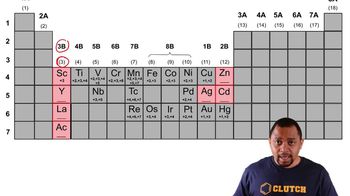
The fourth period includes transition metals, which are characterized by the presence of d electrons. These elements exhibit unique properties due to their electron configurations, contributing to the total count of 18 elements in this period. Transition metals play a significant role in various chemical reactions and applications.
Recommended video:
Guided course
02:22
Periodic Table: Transition Metals Charges Concept 1