
Pearson+ LogoPearson+ Logo
Ch.4 Molecular Compounds
McMurry - Fundamentals of GOB 8th Edition
McMurry8th EditionFundamentals of GOBISBN: 9780134015187Not the one you use?Change textbook
Chapter 4, Problem 65a

Sketch the three-dimensional shape of the following molecules:
a. Methylamine, CH3NH2

Verified step by step guidance
1
Step 1: Identify the central atoms in the molecule. In methylamine (CH₃NH₂), the central atoms are carbon (C) and nitrogen (N). Carbon is bonded to three hydrogen atoms and one nitrogen atom, while nitrogen is bonded to one hydrogen atom and the carbon atom.
Step 2: Determine the electron geometry around each central atom using VSEPR theory. Carbon has four regions of electron density (three single bonds to hydrogen and one single bond to nitrogen), which corresponds to a tetrahedral geometry. Nitrogen has four regions of electron density (three single bonds and one lone pair), which corresponds to a tetrahedral electron geometry but a trigonal pyramidal molecular shape.
Step 3: Sketch the tetrahedral geometry around the carbon atom. Place the carbon atom at the center, with three hydrogen atoms and the nitrogen atom positioned at the vertices of a tetrahedron. Use solid lines for bonds in the plane, wedges for bonds coming out of the plane, and dashed lines for bonds going behind the plane.
Step 4: Sketch the trigonal pyramidal geometry around the nitrogen atom. Place the nitrogen atom at the center, with one hydrogen atom and the bond to carbon positioned at two vertices of the pyramid, and the lone pair occupying the third vertex. The lone pair slightly distorts the bond angles, making them less than the ideal 109.5°.
Step 5: Combine the two geometries into a single three-dimensional sketch of methylamine. Ensure the tetrahedral arrangement around carbon and the trigonal pyramidal arrangement around nitrogen are accurately represented. Label all atoms (C, H, N) and indicate the lone pair on nitrogen.

Verified video answer for a similar problem:

This video solution was recommended by our tutors as helpful for the problem above.
Video duration:
1m
Was this helpful?

Key Concepts

Here are the essential concepts you must grasp in order to answer the question correctly.

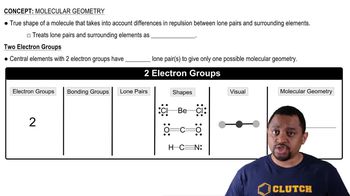
Molecular Geometry

Molecular geometry refers to the three-dimensional arrangement of atoms within a molecule. It is determined by the number of bonding pairs and lone pairs of electrons around the central atom, which influences the shape of the molecule. Understanding molecular geometry is crucial for predicting the physical and chemical properties of substances, including their reactivity and polarity.
Recommended video:
Guided course
01:30
Molecular Geometry (Simplified) Concept 1

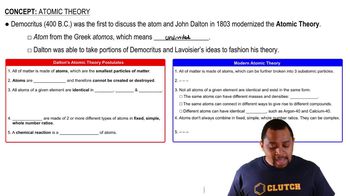
VSEPR Theory

Valence Shell Electron Pair Repulsion (VSEPR) Theory is a model used to predict the geometry of individual molecules based on the repulsion between electron pairs in the valence shell of the central atom. According to VSEPR, electron pairs will arrange themselves to minimize repulsion, leading to specific molecular shapes. This theory is essential for visualizing the 3D structure of molecules like methylamine.
Recommended video:
Guided course
05:22
Atomic Theory

Hybridization

Hybridization is the concept of mixing atomic orbitals to form new hybrid orbitals that can accommodate bonding in a molecule. In the case of methylamine, the nitrogen atom undergoes sp³ hybridization, resulting in four equivalent hybrid orbitals that allow for the formation of sigma bonds with hydrogen and carbon atoms. This concept helps explain the bond angles and overall shape of the molecule.
Recommended video:
Guided course
01:59
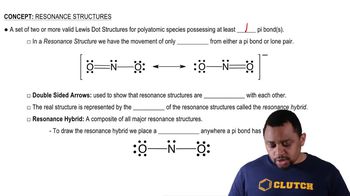
Resonance Structures (Simplified) Concept 1