Pearson+ LogoPearson+ Logo
Ch.4 Molecular Compounds
McMurry - Fundamentals of GOB 8th Edition
McMurry8th EditionFundamentals of GOBISBN: 9780134015187Not the one you use?Change textbook
Chapter 4, Problem 93

The sulfite ion (SO32–) and sulfur trioxide (SO3) have the same chemical formulas but different molecular geometries. Draw the Lewis dot structures and identify the molecular geometry of each.

Verified step by step guidance
1
Step 1: Begin by determining the total number of valence electrons for each species. For the sulfite ion (SO₃²⁻), sulfur contributes 6 electrons, each oxygen contributes 6 electrons, and the ion has an additional 2 electrons due to its charge. For sulfur trioxide (SO₃), sulfur contributes 6 electrons, and each oxygen contributes 6 electrons, with no extra electrons from charge.
Step 2: Draw the Lewis dot structure for the sulfite ion (SO₃²⁻). Place sulfur in the center as the least electronegative atom, and arrange the three oxygen atoms around it. Distribute the valence electrons to satisfy the octet rule for each atom, keeping in mind the extra 2 electrons from the charge. Include resonance structures if applicable.
Step 3: Draw the Lewis dot structure for sulfur trioxide (SO₃). Place sulfur in the center and arrange the three oxygen atoms around it. Distribute the valence electrons to satisfy the octet rule for each atom. Note that sulfur can expand its octet due to its position in Period 3 of the periodic table. Include resonance structures if applicable.
Step 4: Identify the molecular geometry of the sulfite ion (SO₃²⁻) using VSEPR theory. Count the regions of electron density (bonding pairs and lone pairs) around the central sulfur atom. The presence of lone pairs will affect the geometry, resulting in a trigonal pyramidal shape.
Step 5: Identify the molecular geometry of sulfur trioxide (SO₃) using VSEPR theory. Count the regions of electron density around the central sulfur atom. Since there are no lone pairs on sulfur, the geometry will be trigonal planar.

Verified video answer for a similar problem:

This video solution was recommended by our tutors as helpful for the problem above.
Video duration:
7m
Was this helpful?

Key Concepts

Here are the essential concepts you must grasp in order to answer the question correctly.

Lewis Dot Structures

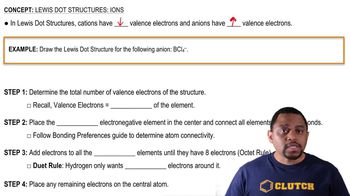
Lewis dot structures are diagrams that represent the valence electrons of atoms within a molecule. They illustrate how electrons are shared or transferred between atoms, helping to visualize bonding and lone pairs. For the sulfite ion (SO₃²⁻) and sulfur trioxide (SO₃), drawing their Lewis structures will reveal the arrangement of electrons and the connectivity of atoms.
Recommended video:
Guided course
03:11
Lewis Dot Structures: Ions (Simplified) Concept 1

Molecular Geometry

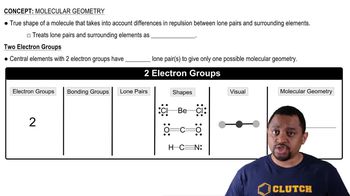
Molecular geometry refers to the three-dimensional arrangement of atoms in a molecule. It is determined by the number of bonding pairs and lone pairs of electrons around the central atom, which influences the shape of the molecule. Understanding the molecular geometry of SO₃²⁻ and SO₃ is crucial for predicting their chemical behavior and reactivity.
Recommended video:
Guided course
01:30
Molecular Geometry (Simplified) Concept 1

VSEPR Theory

Valence Shell Electron Pair Repulsion (VSEPR) theory is a model used to predict the geometry of molecules based on the repulsion between electron pairs. According to VSEPR, electron pairs will arrange themselves to minimize repulsion, leading to specific molecular shapes. This theory is essential for determining the molecular geometries of SO₃²⁻ and SO₃ after constructing their Lewis dot structures.
Recommended video:
Guided course
05:22
Atomic Theory