
Pearson+ LogoPearson+ Logo
Ch.4 Molecular Compounds
McMurry - Fundamentals of GOB 8th Edition
McMurry8th EditionFundamentals of GOBISBN: 9780134015187Not the one you use?Change textbook
Chapter 4, Problem 90b

The phosphonium ion, PH4+ is formed by reaction of phosphine, PH3, with an acid.
b. Predict its molecular geometry.

Verified step by step guidance
1
Step 1: Recognize that the phosphonium ion (PH⁺₄) is formed by the addition of a proton (H⁺) to phosphine (PH₃). This results in a positively charged ion with the formula PH⁺₄.
Step 2: Determine the number of valence electrons for phosphorus (P). Phosphorus is in Group 15 of the periodic table, so it has 5 valence electrons. Each hydrogen atom contributes 1 electron, and there are 4 hydrogen atoms in PH⁺₄. The total number of electrons is 5 + 4 = 9 electrons, but since the ion is positively charged, subtract 1 electron, leaving 8 electrons to distribute.
Step 3: Apply the VSEPR (Valence Shell Electron Pair Repulsion) theory to predict the molecular geometry. In PH⁺₄, phosphorus is the central atom surrounded by 4 bonding pairs of electrons (from the 4 P-H bonds) and no lone pairs.
Step 4: According to VSEPR theory, a molecule with 4 bonding pairs and no lone pairs adopts a tetrahedral geometry to minimize electron pair repulsion. The bond angles in a tetrahedral geometry are approximately 109.5°.
Step 5: Conclude that the molecular geometry of the phosphonium ion (PH⁺₄) is tetrahedral, with phosphorus at the center and the 4 hydrogen atoms arranged symmetrically around it.

Verified video answer for a similar problem:

This video solution was recommended by our tutors as helpful for the problem above.
Video duration:
1m
Was this helpful?

Key Concepts

Here are the essential concepts you must grasp in order to answer the question correctly.

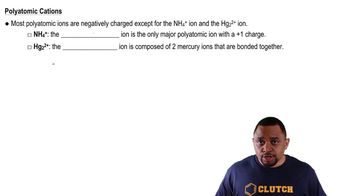
Phosphonium Ion

A phosphonium ion, such as PH₄⁺, is a positively charged species formed when phosphine (PH₃) reacts with an acid. In this ion, phosphorus is bonded to four hydrogen atoms, resulting in a tetrahedral arrangement. The positive charge indicates that the phosphorus atom has an expanded octet, allowing it to accommodate more than eight electrons.
Recommended video:
Guided course
01:16
Polyatomic Ions

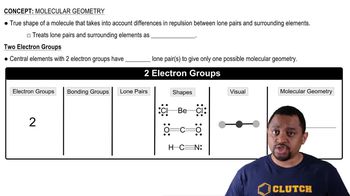
Molecular Geometry

Molecular geometry refers to the three-dimensional arrangement of atoms within a molecule. It is determined by the number of bonding pairs and lone pairs of electrons around the central atom. For PH₄⁺, the tetrahedral geometry arises from four equivalent P-H bonds, leading to bond angles of approximately 109.5 degrees.
Recommended video:
Guided course
01:30
Molecular Geometry (Simplified) Concept 1

VSEPR Theory

Valence Shell Electron Pair Repulsion (VSEPR) theory is a model used to predict the geometry of molecules based on the repulsion between electron pairs. According to VSEPR, electron pairs will arrange themselves to minimize repulsion, resulting in specific molecular shapes. In the case of PH₄⁺, the tetrahedral shape is a direct consequence of this principle, as it allows for optimal spacing between the four bonding pairs.
Recommended video:
Guided course
05:22
Atomic Theory