Pearson+ LogoPearson+ Logo
Ch.4 Molecular Compounds
McMurry - Fundamentals of GOB 8th Edition
McMurry8th EditionFundamentals of GOBISBN: 9780134015187Not the one you use?Change textbook
Chapter 4, Problem 100(iv)

Which of the following elements would you expect to form (iv) both covalent and ionic bonds? (More than one answer may apply; remember that some nonmetals can form ionic bonds with metals.) Explain your answers.
a. Oxygen
b. Potassium
c. Phosphorus
d. Iodine
e. Hydrogen
f. Cesium

Verified step by step guidance
1
Step 1: Understand the nature of covalent and ionic bonds. Covalent bonds occur when atoms share electrons, typically between nonmetals. Ionic bonds occur when electrons are transferred from one atom to another, typically between metals and nonmetals.
Step 2: Analyze each element's position on the periodic table. Nonmetals (like oxygen, phosphorus, iodine, and hydrogen) are more likely to form covalent bonds, while metals (like potassium and cesium) are more likely to form ionic bonds.
Step 3: Determine which elements can form both types of bonds. Nonmetals can form covalent bonds with other nonmetals and ionic bonds with metals. For example, oxygen can form covalent bonds in molecules like H₂O and ionic bonds in compounds like Na₂O.
Step 4: Consider the chemical behavior of each element. Potassium and cesium are alkali metals and typically form ionic bonds. Hydrogen, although a nonmetal, can form covalent bonds (e.g., H₂) and ionic bonds (e.g., H⁺ or H⁻). Phosphorus and iodine, as nonmetals, can also form both covalent and ionic bonds depending on the reacting partner.
Step 5: Summarize the elements that can form both covalent and ionic bonds. Based on the analysis, oxygen, phosphorus, iodine, and hydrogen are capable of forming both types of bonds, while potassium and cesium primarily form ionic bonds.

Verified video answer for a similar problem:

This video solution was recommended by our tutors as helpful for the problem above.
Video duration:
3m
Was this helpful?

Key Concepts

Here are the essential concepts you must grasp in order to answer the question correctly.

Covalent Bonds

Covalent bonds are formed when two nonmetals share electrons to achieve a full outer shell, resulting in a stable electronic configuration. This type of bonding typically occurs between elements with similar electronegativities, allowing them to effectively share their valence electrons. For example, oxygen can form covalent bonds with hydrogen in water (H2O).
Recommended video:
Guided course
01:04
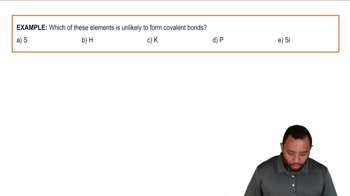
Covalent Bonds Example 1

Ionic Bonds

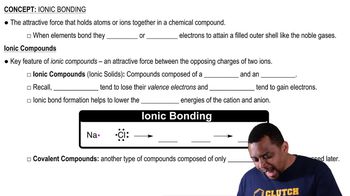
Ionic bonds occur when one atom donates an electron to another, resulting in the formation of charged ions. This typically happens between metals and nonmetals, where metals lose electrons to become positively charged cations, and nonmetals gain electrons to become negatively charged anions. For instance, sodium (a metal) can form an ionic bond with chlorine (a nonmetal) to create sodium chloride (NaCl).
Recommended video:
Guided course
02:33
Ionic Bonding Concept 1

Electronegativity

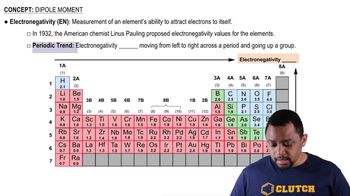
Electronegativity is a measure of an atom's ability to attract and hold onto electrons in a chemical bond. Elements with high electronegativity, such as oxygen and iodine, are more likely to form covalent bonds with other nonmetals, while those with low electronegativity, like potassium and cesium, tend to form ionic bonds with nonmetals. Understanding electronegativity helps predict the type of bond that will form between different elements.
Recommended video:
Guided course
01:51
Dipole Moment (Simplified) Concept 1