Pearson+ LogoPearson+ Logo
Ch.4 Molecular Compounds
McMurry - Fundamentals of GOB 8th Edition
McMurry8th EditionFundamentals of GOBISBN: 9780134015187Not the one you use?Change textbook
Chapter 4, Problem 32

What is a coordinate covalent bond, and how does it differ from a covalent bond?

Verified step by step guidance
1
A coordinate covalent bond, also known as a dative bond, is a type of covalent bond in which both electrons in the shared pair come from the same atom. This is different from a regular covalent bond, where each atom contributes one electron to the shared pair.
To form a coordinate covalent bond, one atom must have a lone pair of electrons (non-bonding electrons), and the other atom must have an empty orbital to accept the electron pair.
For example, in the ammonium ion (NH₄⁺), the nitrogen atom in ammonia (NH₃) donates its lone pair of electrons to bond with a hydrogen ion (H⁺), forming a coordinate covalent bond.
The key difference between a coordinate covalent bond and a regular covalent bond is the origin of the shared electrons. However, once the bond is formed, it behaves like any other covalent bond and is indistinguishable in terms of strength and properties.
In chemical notation, a coordinate covalent bond is sometimes represented with an arrow (→) pointing from the donor atom (the one providing the electron pair) to the acceptor atom.

Verified video answer for a similar problem:

This video solution was recommended by our tutors as helpful for the problem above.
Video duration:
3m
Was this helpful?

Key Concepts

Here are the essential concepts you must grasp in order to answer the question correctly.

Coordinate Covalent Bond

A coordinate covalent bond, also known as a dative bond, occurs when one atom donates both of the electrons that are shared in the bond. This type of bond typically forms between a Lewis acid, which accepts the electron pair, and a Lewis base, which donates the electron pair. An example is the bond between ammonia (NH3) and boron trifluoride (BF3), where NH3 donates a pair of electrons to BF3.
Recommended video:
Guided course
01:04
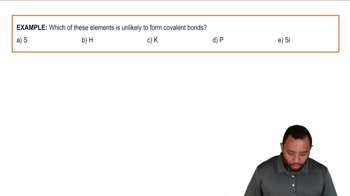
Covalent Bonds Example 1

Covalent Bond

A covalent bond is formed when two atoms share one or more pairs of electrons, allowing each atom to attain a stable electron configuration. This type of bond can be single, double, or triple, depending on the number of shared electron pairs. For instance, in a water molecule (H2O), each hydrogen atom shares one electron with the oxygen atom, resulting in two single covalent bonds.
Recommended video:
Guided course
01:04
Covalent Bonds Example 1

Difference Between Coordinate and Covalent Bonds

The primary difference between coordinate covalent bonds and regular covalent bonds lies in the origin of the shared electrons. In a covalent bond, each atom contributes one electron to the bond, while in a coordinate covalent bond, one atom provides both electrons. This distinction affects the bond's properties and the overall molecular structure, influencing reactivity and stability.
Recommended video:
Guided course
01:04
Covalent Bonds Example 1