Pearson+ LogoPearson+ Logo
Ch.4 Molecular Compounds
McMurry - Fundamentals of GOB 8th Edition
McMurry8th EditionFundamentals of GOBISBN: 9780134015187Not the one you use?Change textbook
Chapter 4, Problem 2

CIA Problem 4.2 Draw the Lewis dot structures for the molecules CO and NO. What is different about these structures compared with the general examples we have seen so far? How could these Lewis structures provide insight into the high chemical reactivity of these molecules?

Verified step by step guidance
1
Step 1: Begin by identifying the total number of valence electrons for each molecule. For CO (carbon monoxide), carbon has 4 valence electrons and oxygen has 6 valence electrons, giving a total of 10 valence electrons. For NO (nitric oxide), nitrogen has 5 valence electrons and oxygen has 6 valence electrons, giving a total of 11 valence electrons.
Step 2: Arrange the atoms in each molecule. For CO, carbon and oxygen are bonded together. For NO, nitrogen and oxygen are bonded together. Place the least electronegative atom (carbon for CO, nitrogen for NO) in the center.
Step 3: Distribute the valence electrons to satisfy the octet rule for each atom, starting with the bonds between the atoms. For CO, you will need to form a triple bond between carbon and oxygen to satisfy the octet rule. For NO, you will form a double bond between nitrogen and oxygen, but note that NO will have an unpaired electron due to the odd number of valence electrons.
Step 4: Draw the Lewis dot structures for each molecule. For CO, the structure will show a triple bond between carbon and oxygen, with lone pairs on oxygen. For NO, the structure will show a double bond between nitrogen and oxygen, with lone pairs on oxygen and an unpaired electron on nitrogen.
Step 5: Discuss the differences and reactivity. Unlike typical examples where all electrons are paired and atoms achieve full octets, NO has an unpaired electron, making it a radical and highly reactive. CO, despite having a full octet, has a strong triple bond and a polar structure, contributing to its reactivity. These Lewis structures highlight the unusual electronic configurations that drive the high chemical reactivity of these molecules.

Verified video answer for a similar problem:

This video solution was recommended by our tutors as helpful for the problem above.
Video duration:
2m
Was this helpful?

Key Concepts

Here are the essential concepts you must grasp in order to answer the question correctly.

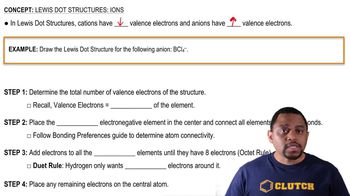
Lewis Dot Structures

Lewis dot structures are diagrams that represent the valence electrons of atoms within a molecule. They illustrate how electrons are shared or transferred between atoms, helping to visualize bonding and lone pairs. These structures are essential for predicting molecular geometry and reactivity, as they highlight the arrangement of electrons around the atoms.
Recommended video:
Guided course
03:11
Lewis Dot Structures: Ions (Simplified) Concept 1

Molecular Reactivity

Molecular reactivity refers to the tendency of a molecule to undergo chemical reactions, which is influenced by its electronic structure. Molecules with unpaired electrons, high electronegativity differences, or specific geometries often exhibit increased reactivity. Understanding the Lewis structures of CO and NO can reveal how their electron configurations contribute to their reactivity, particularly in oxidation and reduction reactions.
Recommended video:
Guided course
02:08
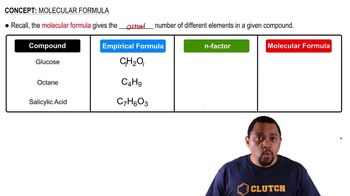
Molecular Formula

Bond Order

Bond order is a concept that indicates the number of chemical bonds between a pair of atoms, which can affect the stability and reactivity of a molecule. It is calculated as the difference between the number of bonding and antibonding electrons divided by two. In the case of CO and NO, their bond orders can provide insight into their strength and the likelihood of participating in chemical reactions, as higher bond orders typically correlate with greater stability.
Recommended video:
Guided course
01:10
Covalent Bonds Concept 1