Pearson+ LogoPearson+ Logo
Ch.6 Chemical Reactions: Mole and Mass Relationships
McMurry - Fundamentals of GOB 8th Edition
McMurry8th EditionFundamentals of GOBISBN: 9780134015187Not the one you use?Change textbook
Chapter 6, Problem 8a

Balance the following equation, and tell how many moles of nickel will react with 9.81 mol of hydrochloric acid.
Ni(s) + HCl(aq) → NiCl2(aq) + H2(g)

Verified step by step guidance
1
Write the unbalanced chemical equation: Ni(s)+HCl(aq)NiCl2(aq)+H2(g).
Balance the equation by ensuring the number of atoms of each element is the same on both sides. Start with nickel (Ni), which is already balanced. Then balance chlorine (Cl) by placing a coefficient of 2 in front of HCl. Finally, balance hydrogen (H) by ensuring there are 2 H atoms on both sides of the equation. The balanced equation is: Ni(s)+2HCl(aq)NiCl2(aq)+H2(g).
Identify the mole ratio between nickel (Ni) and hydrochloric acid (HCl) from the balanced equation. The ratio is 1 mol of Ni to 2 mol of HCl.
Use the given amount of HCl (9.81 mol) to calculate the moles of Ni required. Apply the mole ratio: 12 (1 mol Ni / 2 mol HCl). Set up the calculation as: 9.81×12.
Simplify the calculation to determine the moles of nickel (Ni) that will react with 9.81 mol of HCl. This will give you the final answer.

Verified video answer for a similar problem:

This video solution was recommended by our tutors as helpful for the problem above.
Video duration:
2m
Was this helpful?

Key Concepts

Here are the essential concepts you must grasp in order to answer the question correctly.

Stoichiometry

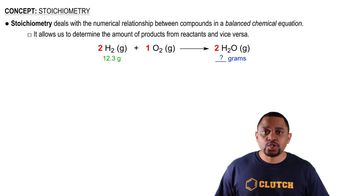
Stoichiometry is the branch of chemistry that deals with the quantitative relationships between the reactants and products in a chemical reaction. It allows us to calculate the amounts of substances consumed and produced in a reaction based on balanced chemical equations. Understanding stoichiometry is essential for determining how many moles of one substance will react with a given amount of another.
Recommended video:
Guided course
01:16
Stoichiometry

Balancing Chemical Equations

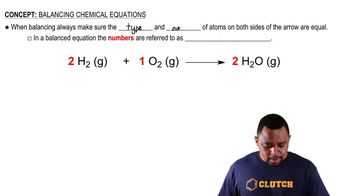
Balancing chemical equations involves ensuring that the number of atoms for each element is the same on both sides of the equation. This is crucial because it reflects the law of conservation of mass, which states that matter cannot be created or destroyed in a chemical reaction. A balanced equation provides the correct stoichiometric ratios needed to calculate the moles of reactants and products.
Recommended video:
Guided course
01:32
Balancing Chemical Equations (Simplified) Concept 1

Mole Concept

The mole concept is a fundamental principle in chemistry that defines a mole as a specific quantity of particles, typically 6.022 x 10^23 (Avogadro's number). It allows chemists to convert between the mass of a substance and the number of particles or moles. Understanding the mole concept is vital for performing calculations involving the amounts of reactants and products in chemical reactions.
Recommended video: