
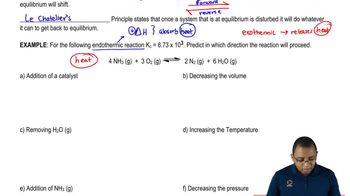
Is the yield of SO3 at equilibrium favored by a higher or lower pressure? By a higher or lower temperature?
2 SO2(g) + O2 ⇌ 2 SO3(g) ∆H = -47 kcal/mol
Verified step by step guidance
Is the yield of SO3 at equilibrium favored by a higher or lower pressure? By a higher or lower temperature?
2 SO2(g) + O2 ⇌ 2 SO3(g) ∆H = -47 kcal/mol
What effect do the listed changes have on the position of the equilibrium in the reaction of carbon with hydrogen?
C(s) + 2 H2(g) ⇌ CH4(g) ∆H = -18 kcal/mol (-75kJ/mol)
a. Increasing temperature
What effect do the listed changes have on the position of the equilibrium in the reaction of carbon with hydrogen?
C(s) + 2 H2(g) ⇌ CH4(g) ∆H = -18 kcal/mol (-75kJ/mol)
b. Increasing pressure by decreasing volume
Two curves are shown in the following energy diagram:
b. Which curve represents the spontaneous reaction, and which the nonspontaneous?
The following diagram portrays a reaction of the type A(s) → B(g) + C(g), where the different-colored spheres represent different molecular structures. Assume that the reaction has ∆H = +9.1 kcal/mol (+38.1 kJ/mol).
a. What is the sign of ∆S for the reaction?
The following diagram portrays a reaction of the type A(s) → B(g) + C(g), where the different-colored spheres represent different molecular structures. Assume that the reaction has ∆H = +9.1 kcal/mol (+38.1 kJ/mol).
b. Is the reaction likely to be spontaneous at all temperatures, nonspontaneous at all temperatures, or spontaneous at some but nonspontaneous at others?