Pearson+ LogoPearson+ Logo
Ch.7 Chemical Reactions: Energy, Rate and Equilibrium
McMurry - Fundamentals of GOB 8th Edition
McMurry8th EditionFundamentals of GOBISBN: 9780134015187Not the one you use?Change textbook
Chapter 7, Problem 48a

The reaction between hydrogen gas and carbon to produce the gas known as ethylene is:
2 H2(g) + 2 C(s) → H2C=CH2(g), ∆G = +16.3 kcal/mol (+68 kJ/mol) 25 °C.
a. Is this reaction spontaneous at 25 °C?

Verified step by step guidance
1
Step 1: Recall the concept of spontaneity in chemical reactions. A reaction is spontaneous if the Gibbs free energy change (∆G) is negative. If ∆G is positive, the reaction is non-spontaneous under the given conditions.
Step 2: Analyze the given information. The problem states that the Gibbs free energy change (∆G) for the reaction is +16.3 kcal/mol (+68 kJ/mol) at 25 °C. Since ∆G is positive, this suggests the reaction is not spontaneous under these conditions.
Step 3: Understand the implications of a positive ∆G. A positive ∆G means that the reaction requires an input of energy to proceed and will not occur on its own at the given temperature (25 °C).
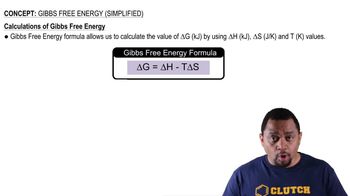
Step 4: Consider the temperature dependence of ∆G. The spontaneity of a reaction can change with temperature, as ∆G is related to enthalpy (∆H), entropy (∆S), and temperature (T) by the equation: ΔG=ΔHTΔS. However, no additional information about ∆H or ∆S is provided in this problem.
Step 5: Conclude that the reaction is non-spontaneous at 25 °C based on the positive ∆G value provided. If conditions such as temperature or energy input change, the spontaneity of the reaction may need to be re-evaluated.

Verified video answer for a similar problem:

This video solution was recommended by our tutors as helpful for the problem above.
Video duration:
1m
Was this helpful?

Key Concepts

Here are the essential concepts you must grasp in order to answer the question correctly.

Gibbs Free Energy (∆G)

Gibbs Free Energy (∆G) is a thermodynamic potential that measures the maximum reversible work obtainable from a thermodynamic system at constant temperature and pressure. A negative ∆G indicates that a reaction is spontaneous, while a positive ∆G suggests that the reaction is non-spontaneous. In this case, the given ∆G of +16.3 kcal/mol indicates that the reaction is not spontaneous at 25 °C.
Recommended video:
Guided course
01:04
Gibbs Free Energy (Simplified) Concept 3

Spontaneity of Reactions

The spontaneity of a chemical reaction refers to whether it can occur without external intervention. This is determined by the change in Gibbs Free Energy (∆G). If ∆G is negative, the reaction is spontaneous; if positive, it is non-spontaneous. Understanding this concept is crucial for predicting the behavior of chemical reactions under specific conditions.

Temperature and Reaction Dynamics

Temperature plays a significant role in chemical reactions, influencing both the rate and spontaneity. The Gibbs Free Energy equation incorporates temperature, as it affects the enthalpy and entropy of the system. In this case, the reaction's non-spontaneity at 25 °C suggests that increasing the temperature may alter the reaction dynamics, potentially making it more favorable under different conditions.
Recommended video:
Guided course
01:30
Temperature (Simplified) Concept 1