
Pearson+ LogoPearson+ Logo
Ch.7 Chemical Reactions: Energy, Rate and Equilibrium
McMurry - Fundamentals of GOB 8th Edition
McMurry8th EditionFundamentals of GOBISBN: 9780134015187Not the one you use?Change textbook
Chapter 7, Problem 65b

The reaction H2(g) + I2(g) ⇌ 2 HI(g) has ∆H = -2.2 kcal/mol (-9.2 kJ/mol). Will the equilibrium concentration of HI increase or decrease when
b. H2 is removed?

Verified step by step guidance
1
Identify the type of reaction: The reaction is exothermic because the enthalpy change (∆H) is negative (-2.2 kcal/mol). This means heat is released as the reaction proceeds forward.
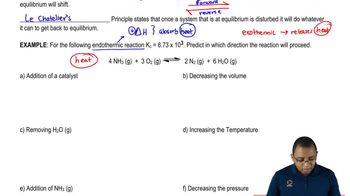
Understand the effect of removing H2: According to Le Châtelier's Principle, if a reactant (H2 in this case) is removed, the equilibrium will shift to counteract the change by producing more H2. This means the reaction will shift to the left (toward the reactants).
Analyze the impact on HI concentration: Since the reaction shifts to the left, the concentration of the product (HI) will decrease as the system works to re-establish equilibrium.
Summarize the relationship: Removing H2 reduces the availability of one of the reactants, which forces the equilibrium to favor the reverse reaction, thereby decreasing the concentration of HI.
Conclude the answer: The equilibrium concentration of HI will decrease when H2 is removed, as the system shifts to restore balance by producing more H2 and I2.

Verified video answer for a similar problem:

This video solution was recommended by our tutors as helpful for the problem above.
Video duration:
1m
Was this helpful?

Key Concepts

Here are the essential concepts you must grasp in order to answer the question correctly.

Le Chatelier's Principle

Le Chatelier's Principle states that if a dynamic equilibrium is disturbed by changing the conditions, the system will adjust to counteract the change and restore a new equilibrium. In this case, removing H2 will shift the equilibrium position to favor the production of H2 to compensate for its loss.

Equilibrium Constant (K)

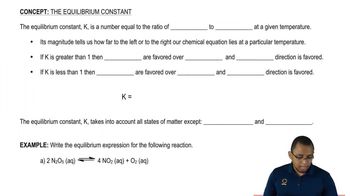
The equilibrium constant (K) is a numerical value that expresses the ratio of the concentrations of products to reactants at equilibrium for a given reaction at a specific temperature. Changes in concentration of reactants or products can affect the position of equilibrium but not the value of K itself.
Recommended video:
Guided course
02:50
The Equilibrium Constant Concept 1

Reaction Quotient (Q)

The reaction quotient (Q) is a measure of the relative concentrations of products and reactants at any point in time, not just at equilibrium. By comparing Q to K, one can predict the direction in which the reaction will shift to reach equilibrium. If H2 is removed, Q will change, prompting the system to shift towards the reactants.
Recommended video:
Guided course
1:30
Alcohol Reactions: Dehydration Reactions Concept 1