Pearson+ LogoPearson+ Logo
Ch.8 Gases, Liquids and Solids
McMurry - Fundamentals of GOB 8th Edition
McMurry8th EditionFundamentals of GOBISBN: 9780134015187Not the one you use?Change textbook
Chapter 8, Problem 68

Explain Avogadro's law using the kinetic–molecular theory of gases.

Verified step by step guidance
1
Avogadro's law states that at constant temperature and pressure, the volume of a gas is directly proportional to the number of moles of gas present. Mathematically, this can be expressed as: V=kn, where V is the volume, n is the number of moles, and k is a proportionality constant.
The kinetic–molecular theory of gases explains the behavior of gas particles. It assumes that gas particles are in constant random motion, and the pressure exerted by a gas is due to collisions of the particles with the walls of the container.
When the number of gas particles (moles) increases at constant temperature and pressure, the frequency of collisions with the container walls increases. To maintain constant pressure, the volume of the container must increase to reduce the collision frequency per unit area.
This relationship between the number of gas particles and the volume aligns with Avogadro's law, as the increase in volume compensates for the increased number of particles, keeping the pressure constant.
In summary, Avogadro's law is supported by the kinetic–molecular theory because the theory explains how gas particles behave and interact, leading to the observed proportionality between volume and the number of moles of gas.

Verified video answer for a similar problem:

This video solution was recommended by our tutors as helpful for the problem above.
Video duration:
4m
Was this helpful?

Key Concepts

Here are the essential concepts you must grasp in order to answer the question correctly.

Avogadro's Law

Avogadro's Law states that equal volumes of gases, at the same temperature and pressure, contain an equal number of molecules. This principle implies that the volume of a gas is directly proportional to the number of moles of the gas present, allowing for the calculation of gas quantities in chemical reactions and stoichiometry.
Recommended video:
Guided course
00:58
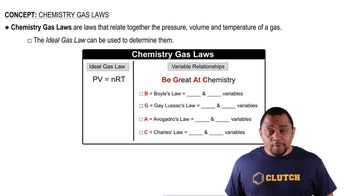
Chemistry Gas Laws Concept 1

Kinetic-Molecular Theory

The Kinetic-Molecular Theory explains the behavior of gases in terms of particles in constant motion. It posits that gas molecules are in rapid, random motion and that their collisions with each other and the walls of their container result in pressure. This theory helps to understand how temperature and volume changes affect gas behavior.
Recommended video:
Guided course
01:19
Kinetic Molecular Theory Concept 1

Relationship Between Volume and Mole Number

The relationship between volume and mole number, as described by Avogadro's Law, indicates that increasing the number of gas molecules in a container at constant temperature and pressure will increase the volume. This relationship is crucial for understanding gas behavior and is derived from the assumptions of the Kinetic-Molecular Theory, which links molecular motion to macroscopic properties.
Recommended video: