Pearson+ LogoPearson+ Logo
Ch.9 Solutions
McMurry - Fundamentals of GOB 8th Edition
McMurry8th EditionFundamentals of GOBISBN: 9780134015187Not the one you use?Change textbook
Chapter 9, Problem 38b

The solubility of NH3 gas in water at an NH3 pressure of 760.0 mmHg and 25°C is 51.8 g/100 mL and 27.0 g/100 mL at 50°C.
b. How many moles of NH3 would be released from 1.0 L of a saturated NH3 solution if the temperature was increased from 25 to 50 °C?

Verified step by step guidance
1
Step 1: Understand the problem. The solubility of NH₃ decreases as the temperature increases. At 25°C, the solubility is 51.8 g/100 mL, and at 50°C, it is 27.0 g/100 mL. You are tasked with determining how many moles of NH₃ would be released from 1.0 L of a saturated solution when the temperature increases from 25°C to 50°C.
Step 2: Calculate the mass of NH₃ dissolved in 1.0 L of solution at 25°C. Use the solubility value at 25°C (51.8 g/100 mL). Since 1.0 L = 1000 mL, multiply the solubility by the volume: \( \text{Mass of NH₃ at 25°C} = 51.8 \text{ g/100 mL} \times 1000 \text{ mL} / 100 \).
Step 3: Calculate the mass of NH₃ dissolved in 1.0 L of solution at 50°C. Use the solubility value at 50°C (27.0 g/100 mL). Similarly, multiply the solubility by the volume: \( \text{Mass of NH₃ at 50°C} = 27.0 \text{ g/100 mL} \times 1000 \text{ mL} / 100 \).
Step 4: Determine the mass of NH₃ released. Subtract the mass of NH₃ dissolved at 50°C from the mass dissolved at 25°C: \( \text{Mass released} = \text{Mass at 25°C} - \text{Mass at 50°C} \).
Step 5: Convert the mass of NH₃ released to moles. Use the molar mass of NH₃ (17.03 g/mol): \( \text{Moles of NH₃ released} = \text{Mass released} / \text{Molar mass of NH₃} \).

Verified video answer for a similar problem:

This video solution was recommended by our tutors as helpful for the problem above.
Video duration:
2m
Was this helpful?

Key Concepts

Here are the essential concepts you must grasp in order to answer the question correctly.

Solubility

Solubility refers to the maximum amount of a substance that can dissolve in a given volume of solvent at a specific temperature and pressure. In this case, the solubility of ammonia (NH₃) in water is provided at two different temperatures, indicating how temperature affects the amount of gas that can be dissolved in the liquid.
Recommended video:
Guided course
00:28
Solubility Rules

Molarity and Moles

Molarity is a measure of concentration defined as the number of moles of solute per liter of solution. To find the number of moles of NH₃ released when the temperature increases, one must first calculate the moles present in the saturated solution at both temperatures and then determine the difference.
Recommended video:

Temperature Effect on Solubility

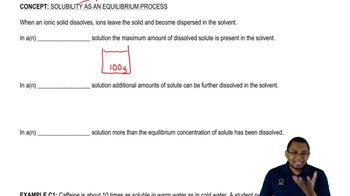
The temperature effect on solubility describes how the solubility of gases typically decreases as temperature increases. This phenomenon is crucial for understanding the change in the amount of NH₃ that can remain dissolved in water when the temperature rises from 25°C to 50°C, leading to the release of gas into the atmosphere.
Recommended video:
Guided course
04:38
Solubility: Temperature Effect Concept 1