Pearson+ LogoPearson+ Logo
Ch.9 Solutions
McMurry - Fundamentals of GOB 8th Edition
McMurry8th EditionFundamentals of GOBISBN: 9780134015187Not the one you use?Change textbook
Chapter 9, Problem 2

Which of the following pairs of substances would you expect to form solutions?
a. CCl4 and water
b. Benzene (C6H6) and MgSO4
c. Hexane (C6H14) and heptane (C7H16)
d. Ethyl alcohol (C2H5OH) and heptanol (C7H15OH)

Verified step by step guidance
1
Step 1: Recall the principle 'like dissolves like,' which means that polar substances tend to dissolve in polar solvents, and nonpolar substances tend to dissolve in nonpolar solvents. This principle will guide us in determining whether the given pairs of substances are likely to form solutions.
Step 2: Analyze pair (a): Carbon tetrachloride (CCl₄) is a nonpolar molecule, while water is a polar molecule. Since they have different polarities, they are unlikely to form a solution.
Step 3: Analyze pair (b): Benzene (C₆H₆) is a nonpolar molecule, while magnesium sulfate (MgSO₄) is an ionic compound that dissolves in polar solvents like water. Since benzene is nonpolar and MgSO₄ requires a polar solvent, they are unlikely to form a solution.
Step 4: Analyze pair (c): Hexane (C₆H₁₄) and heptane (C₇H₁₆) are both nonpolar hydrocarbons. Since they share similar nonpolar characteristics, they are likely to form a solution.
Step 5: Analyze pair (d): Ethyl alcohol (C₂H₅OH) and heptanol (C₇H₁₅OH) are both polar molecules due to the presence of the hydroxyl (-OH) group. Since they are both polar, they are likely to form a solution.

Verified video answer for a similar problem:

This video solution was recommended by our tutors as helpful for the problem above.
Video duration:
6m
Was this helpful?

Key Concepts

Here are the essential concepts you must grasp in order to answer the question correctly.

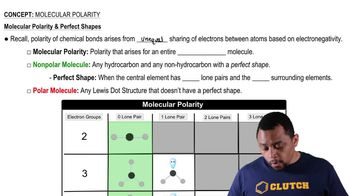
Polarity

Polarity refers to the distribution of electrical charge over the atoms in a molecule. Polar molecules, like water, have a significant difference in electronegativity between their atoms, leading to partial positive and negative charges. Nonpolar molecules, such as CCl₄ and hexane, have an even distribution of charge. The principle 'like dissolves like' indicates that polar substances tend to dissolve in polar solvents, while nonpolar substances dissolve in nonpolar solvents.
Recommended video:
Guided course
01:34
Molecular Polarity (Simplified) Concept 1

Solubility

Solubility is the ability of a substance to dissolve in a solvent at a given temperature and pressure. It is influenced by factors such as temperature, pressure, and the nature of the solute and solvent. For example, ionic compounds like MgSO₄ are generally soluble in polar solvents like water, while nonpolar solutes like hexane are more soluble in nonpolar solvents. Understanding solubility helps predict which pairs of substances will form solutions.
Recommended video:
Guided course
00:28
Solubility Rules

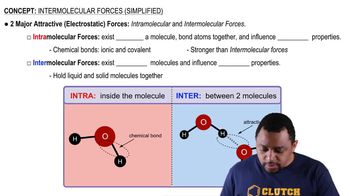
Intermolecular Forces

Intermolecular forces are the forces of attraction or repulsion between neighboring particles (atoms, molecules, or ions). These forces include hydrogen bonding, dipole-dipole interactions, and London dispersion forces. The strength and type of intermolecular forces present in the substances determine their solubility in one another. For instance, ethyl alcohol and heptanol can form hydrogen bonds, making them likely to dissolve in each other.
Recommended video:
Guided course
01:59
Intermolecular Forces (Simplified) Concept 1